
S1E1: WARSHIP
FADE IN:EXT. A MISTY FOREST - MORNINGCICADASA puddle reflects what may as well be a Bierstadt. SPLASH! A pair of boots stamp out the image.DANIEL COLSONThe quintessential hick. Waist-high waders and a paper sack breakfast in hand.A startled herd of deer bolt from the brush ahead, running away from the ruckus. He places the folded top of the paper sack between his teeth. He climbs the log and holds up an imaginary rifle as they disappear into the fog.He perspires heavily.AN OWL ON A TREE BRANCHHe continues walking, and the trees thin. The fog clears.Behind him, open sky.He bends out of view and returns, placing a hard hat on his head. His other arm slings an orange safety vest over his shoulder.The back of the vest reads: Wayne Timber, LLC.He bends again, elbow jerking with the mechanical rattle of a two-cycle motor.His thumb presses the primer, gummed over with sawdust and grease.Fuel and air bubbles fill the line.He stands again, wiping the sweat from his forehead with the back of his hand.The slope gives way behind him as he yanks the pull rope again.He stands, pulling a chainsaw into view.He pulls the rope several times more then stops, looking out over the clearcut valley.For miles, only dirt and stumps.He pulls the rope again, and the chainsaw roars to life.He squeezes the accelerator. The motor buzzes, and smoke fills the air around him.THE CHAINSAWDigs into the bark of a pine tree, angling back and forth at the hilt. Opposite him, a large metal tree spike protrudes from the bark. The more he angles, the closer the chain comes to the spike.CHINK-CHINK-CHINKThe metal of the chain makes contact, and the saw jerks.His eyes widen, but it’s too late.The chain snaps, whips loose, coming around and off the bar.It smacks Daniel in the face, splitting it near in two.He staggers, hands trembling, and collapses backward, downhill. Blood darkens the moss.His limbs move erratically, hands grasping at the earth as he gurgles blood.One of his boots swings under a bush, kicking up several small pieces of human bone.One of his eyes is a large gash, the other wide and glassy.MATCH CUT TO:EXT. U.S.S. RAZORBACK — DAYNORA BLACKPeers through a monocular. AN OLD DECOMMISSIONED SUBMARINE sits, docked along the river’s edge. She stands on the deck.THE MAIN STREET BRIDGE stretches the river in front of her. Beyond that — through the thick humidity — lies Rock City’s modest commercial district.A tourist leans from a port window.Others walk past Nora to the exit. WAVES LAP THE HULLA barge crawls along the water beneath the bridge. THROUGH THE MONOCULARShe scans the barge, moving from the I.D. number on the bow to the sparse crew members, and over the tarp of the cargo hold.WAYNE TIMBER, LLC. - MIDHEAVEN, ARACL-21315THE MONOCULAR SHUTTER SNAPSNora lifts the mic on her headphones.NORAAlpha-lima-charlie-2-1-3-5-9. It’s passing under the Main Street Bridge right now. RUBY (FILTERED)Got it.NORAThat puts them at the lock... (checks the time) in about an hour.RUBY (FILTERED)That’s plenty of time.Nora lowers the monocular, placing it into a small handbag.She references something in a pocketbook, then replaces it.Her long, bronze legs glisten in the hot July sun, her face dappled with beads of sweat.A FOREST GREEN 70s MG CONVERTIBLE sits in the parking lot with the top down. Nora opens the driver-side door and slides in.SLAM!The key turns, and she moves the gearshift to “D”.THE TAGS: BLCKPIA pedestrian leaps out of the way as the MG fishtails from the lot.SUPER: BLACK P.I.The MG darts along the street, nimble, every vibration and rattle palpable.She crosses the Main Street Bridge into Downtown Rock City, weaving lane-to-lane around the other vehicles.RUBY (FILTERED)Why’s it so far out?NORAThere’s probably about a dozen overlapping jurisdictions at the dam. RUBY (FILTERED)Okay. Nora blows through a red light. Horns blare after her.RUBY (FILTERED)Wait, is this legal?NORADon’t worry. It’s a clown car of egos and more than any department really wants to spend. And the paperwork.RUBY (FILTERED)So totally illegal. The MG speeds down a narrow street lined with parked cars. NORAUmm... no. Let me know what you find.Nora hangs up.CUT TO:EXT. RUBY’S HOUSE — DAYA CUSTOM BMW MOTORCYCLEParked at the curb. RUBY RED walks down the sidewalk with a backpack.She swings a leg over the seat, turns the key, kicks the stand, and speeds off.CUT TO:INT. RUTH’S HOUSE - DAYA WELL-MAINTAINED OLD CRAFTSMAN FARM HOUSE IN THE COUNTRYSIDEPICTURES OF DANIEL AT DIFFERENT AGESDOILIESPLASTIC FLOWERSA SOFA WITH A GAUDY PRINTRUTH COLSON sits in her La-Z-boy, back straight. One arm extends straight out, holding a mirror. The other brushes silver hair that runs the length of her torso, giving way at the waist to an ankle-length denim skirt.On the side table between her and the mirror, a scented candle burns beside a framed image of Daniel.A KNOCK AT THE DOORJeb barks.RUTHJeb, hush (Snaps her fingers). Jeb! Hush up now. Be quiet.Ruth crosses the living room to the hall and opens the front door.TOM, THE SHERIFF — TALL, FAT, HAT IN HANDRUTHWell, hello Tom. What’re you doing out here? TOMHiya, Ruthie.RUTHCome on in. Would you like a piece of pie?She watches his expression, sees the placement of his hat.TOMI’m here about Daniel. He hesitates.RUTHWhat’s he done now?TOMWell—and I’m real sorry, Ruth. He was killed this morning out in the forest. CUT TO:EXT. HIGHWAY 161 - DAYRuby speeds down a two-lane highway. On one side, the Delta. On the other, fat-bottomed trees in the water at the edge of a lake. She shifts gears and passes a semi.CUT TO:INT. NORA’S OFFICE - DAYNORA TWISTS THE WANDOn the window blinds, narrowing the light. A LADDER OF SHADOWSClimbs over the room. Incense smoke wafts through the lattice of the blinds’ silhouette.THE LIGHT NARROWS AROUND HER EYESAs she surveys the city.THE HORIZON Is an array of oranges, purples, and crimson behind the forested Ouachita foothills — Rock City.SHE TURNS TO A LARGE DESKThe city disappears into the horizon through the window behind her.Across from her sits a Latino family of four.THE MOTHEROnly speaks Spanish. She’s middle-aged, no husband. A boy, about 7, lies on the floor with crayons and a coloring book. His sister, around 5, shyly hides behind the mother, peeking around at Nora with one eye.BRANDI About 18, the elder daughter, translates. A LOCKETSits on the desk in front of Nora. Inside is a picture of GWEN.NORABlack, P.I.’s transitioning to community ownership. So the assemblies have some say in which cases I take. BRANDIMy cousin said you, specifically, find people like Gwen.NORASpecifically, yes. We have to be selective, so let’s see what kind of case you’ve got, exactly.Brandi translates, and the mother slides a manila folder across the desk.Photos and papers spill out: Directorate of Immigration Enforcement (DIE) forms, a picture of Gwen smiling at a picnic, her birth certificate, a folded police report with the Midheaven Sheriff’s crest partially rubbed away.NORAThis is Gwen?MOTHERSí.BRANDIMy sister. She disappeared last Fourth of July.Nora looks at the photo. Gwen wears the same necklace as the one on the desk. Nora picks it up.NORAAnd this was hers?BRANDIThat’s my mom’s (speaks Spanish to the mother).MOTHERElla tiene la otra mitad.BRANDIIt’s a mother-daughter matching locket. Gwen has the other one.Something in the paperwork catches Nora’s attention. MIDHEAVENRICHMON FOODSShe rifles through another stack of papers on her desk, related to another case.She disappears for a moment, glancing back and forth between the folders.NORADid you say Midheaven?BRANDIYeah, she worked nights at Richmon Foods. But they had a lot of DIE raids.Nora finds the paper she’s looking for, and leans back in her chair, examining it carefully.NORAWas she detained?BRANDIWe called all the centers, but we didn’t find her.Nora sighs, stands, and turns, looking out her office window across the city, thinking.NORAA lot of paper trails stop in detention.She turns back toward the family.NORAWhat about the police?BRANDIThey just said maybe she doesn’t want to be found.Nora scoffs and shakes her head.CUT TO:INT. RUTH’S HOUSE — DAYRuth sits back in her recliner. Black mascara streaks line her cheeks. Tom comes out of the kitchen with a glass of water.TOMForensics were still out when I left, but it ain’t rocket science. He drags a chair from the kitchen table.TOM Big metal spike in the tree he was cutting on.RUTHWhat for?TOM“Forest defenders,” they hammer them in to bust up the chains.Ruth looks disgusted.RUTHThat’s terrorism. TOMMight as well be.RUTHWhere is he?TOMThey took him to the medical examiner’s in Rock City. She looks at Tom a long time without blinking. He clears his throat.TOMState came in real quick like. Seems they found something else.RUTHSomething else what?He tilts his head forward slightly, raising his eyebrows, and widening his eyes with some shared understanding.Ruth averts his gaze, thinking.RUTHWell, if it ain’t one thing.He looks at her sympathetically.TOMIt’s a memory.Tom nods softly.CUT TO:EXT. DAVID TERRY LOCK & DAM — DAYRuby steers her motorcycle down a dirt road and stops. THE DAM looms large in the distance ahead.THE BARGE transits the lock, moving lower, out of sight, metal groaning as the water rushes out.Ruby twists the accelerator a few times, then continues down the road slowly.A SKI-BOATIdles below the dam.CUT TO:INT. NORA’S OFFICE - DAY.BRANDIShe went to a fireworks show, but she felt bad and left.NORA pushes a pen and sheet of paper across the desk.NORACan you write the friend’s number for me? About what time was that?BRANDIAfter dark.The mother picks up her phone and scrolls her contacts.NORAWhat did her work say?BRANDINo call, no show. My mom still tries to talk to the manager. They just keep saying they’ll call back. But they never do.NORAAny coworkers? Brandi speaks in Spanish.The mother searches in her phone again, scrawling hurriedly across the paper.BRANDIShe’ll find everyone she can.THE LITTLE GIRLMoves from behind her mother and stands looking at a large stone reproduction of the Ceremony of the Weighing of the Heart of the Dead, set on a shelf on Nora’s wall.NORA NOTICES but keeps her focus on the interview. THE GIRL’S BROWN EYES THE STONE TABLETANUBIS, THE HEART, THE MONSTER AMMUTCUT TO:INT. RUTH’S HOUSE — DAYTOMI don’t think Wayne’s supposed to be out around there anyway.Ruth shrugs.TOMAin’t nothing but trees and, well--RUTHWayne belongs wherever they happen to be. But even I didn’t think they’d stretch out that far.TOMMe neither. Could be Danny was lost.RUTHI really doubt he’d forget that place.TOMProbably not.Ruth leans back in her recliner and lets out a sigh.RUTHIf he was kiping timber, what kind of mother are people going to think I am?TOMIt’s them leftist hippy types, Ruthie. Ain’t nobody got no right to think anything. RUTHI already got one son...She trails off.RUTHWhat are you going to do about this, Tom?CUT TO:EXT. DAVID TERRY LOCK & DAM - DAYCICADAS Ruby’s motorcycle growls through the gravel parking lot. She steps off the bike, pulls a camera from her backpack, and jogs along the retaining wall.She peers around the corner, downriver.The barge moves steadily out of the lock toward the ski-boat idling ahead.She aims the camera, takes a few snaps, adjusting the telescope, then looks at the display.Dissatisfied, she scans the tree-line running parallel to the river. Stepping away from the wall, she casually walks into the thick brush, keeping her eyes on the barge as she disappears into the trees.CUT TO:INT. NORA’S OFFICE - DAYGwen’s mother gathers the last of the photos back into the manila folder.Brandi finishes writing their contacts on a sheet of paper and slides it across the desk to Nora.BRANDIThat’s everyone we can think of.NORAShe’s been missing awhile. That means my chances of finding her aren’t the best.Brandi translates. The mother clutches the locket in her fist, eyes wet. She thanks Nora in Spanish.MOTHERElla va a volver.BRANDIShe says Gwen will come back.Nora watches the mother’s eyes as she speaks.The little girl turns away from the Egyptian tablet to Nora, pointing up at the scene.LITTLE GIRLWhat’s that?NORAThat’s the Ceremony of the Weighing of the Heart of the Dead. It’s Egyptian.The family moves toward the door, the mother gratuitously thanking Nora in Spanish.NORAYou know where to find me.The door closes.CUT TO:INT. RUTH’S HOUSE - DAYAt the kitchen counter, Ruth cuts a slice of cherry pie. There is cherry sauce on the fingers of one of her hands. She presses them into a perfectly white cloth napkin on the counter. She places the knife in the napkin too, folding it around the blade.Tom steps out onto the porch, holding the pie on a small styrofoam plate in a ziplock bag.He puts his hat back on his head and walks to his cruiser.ON THE DOOR: MIDHEAVEN COUNTY SHERIFFRuth watches from the porch, eyes following him until the cruiser leaves the driveway.CUT TO:EXT. DAVID TERRY LOCK & DAM - DAYBranches slap at Ruby as she makes her way through the thick brush. She pulls a balaclava from her neck over her nose as she reaches an opening. The camera shutter clicks.She adjusts her footing without taking her eyes from the camera.The ledge gives way, and she reaches for a nearby bush, grabbing its branches, but it tears out by the roots. Her other hand grasps for a vine covered in thorns, scratching her fingers and palm.Awkwardly, she rolls down the embankment and into the water at the river’s edge.The men on the boats turn as she holds the camera out of the waist-deep water, trying to move along the embankment.One of the men on the ski boat sees the camera and kneels to retrieve a bolt-action hunting rifle and a box of ammunition from a storage area.He rushes to load the gun, spilling the ammo.Ruby nears the parking lot.WIZZ!A soft thud as a cloud dust comes out of the embankment inches above her head.He chambers another round.She trips trying to come out of the water too quickly.CRACK!Bark on a tree behind her explodes.She drops the camera, pulls a 9mm from her hip, and unloads in the direction of the boats.The man dives, losing his grip on the rifle, fumbling desperately for the throttle. The motor screams as the bow lifts, and he rolls backward on the floor, trying to stand and regain control of the boat.Ruby gets back on her feet, retrieves the camera, and sprints to her motorcycle.Alarms whine from the dam control tower.The ski boat turns sharply, headed back toward the dam.Ruby starts the bike and kicks up a cloud of dust as she whips the motorcycle around to face the entrance.The man lifts the rifle, following the bike, but he lowers it instead of firing.ACT IICUT TO:INT. THE UPRISING - DAYTHROUGH THE PLEXIGLASS PORT of a whirring bread machine, a ball of dough rumbles around inside. SHELVES LINED WITH BREAD MACHINES cover the bakery’s walls. Floor-to-ceiling. Front-to-back. WILL MCKINLEY, sweating, walks quickly through with a burlap sack of flour over his shoulder. He drops it on the counter in the bakery’s rear. He pats his hands together, and puffs of flour dust hang in the air like smoke.The bread machines whir and shake, beep and overheat. One steams, soggy dough squeezing through the lid and over the sides.SELAH turns at the sound of hissing.SELAHShit.She pushes away from her mixing bowl and speed-walks to the overflowing bread machine, pulling the pan and rushing it to the sink.Will looks up for a half-second, barely registering the accident as he slips behind the computer.WILLFree lunch.SELAHYeah right.He pounds on the keyboard, shakes the mouse, then smacks the side of the monitor.WILLEvery fucking thing is breaking today, I’m gonna spend all our money on RAM and parts for the press.He pushes the power button on back of the monitor, forcing a hard reset, then backs away with his hands knotted on top of his head.WILL(Smiling) Remember, we have the econ council today for lunch.SELAHRight. We need more stone-milled hard white.Will’s phone rings. He holds up the screen and rolls his head, pinches his eyes.WILLBethany.He walks briskly around the counter toward the door. About halfway, he stops, listening. A hum shifts pitch, then steadies. He looks at Selah, then lets out a breath.WILLHey Bethany.He exits to the parking lot.A PINT MASON JARHidden on the shelf behind the bread machines, leans to one side, filled with a clear fluid. A LARGER MASON JARSits next to it, filled with a viscous red liquid. Selah’s movements jostle both jar’s contents as she cleans the spill.A pencil props up the pint jar, slightly angled, pulled by a rubber band wrapped around its mouth on one end, a nail on the other.Selah returns to the rear, adding even measurements of several ingredients to a series of containers. THE RUBBER BANDTightens, leathery, pulling the jar’s base away from the pencil, toward a pile of purple powder.A fuse bifurcates toward a single 12-gauge shotgun shell suspended over two half-pound bricks of tannerite.A small digital timer blinks: 0:05.Will re-enters.WILLThere’ll be nine, including me and you.SELAHI’m gonna need an assistant.WILLHow about a few more bread machines instead? Maybe there’s a sweet spot so you can retire.Selah reads an issue of CITIZEN:MODERN, glancing up at Will, smiling.SELAH“Timber Heist Gone Wrong.”WILLThe Gazette called us saboteurs.SELAHI didn’t know you could steal timber.Selah skims the article but is more focused on baking.WILLExactly. And, yeah, over $500 is a felony. But I doubt anyone will be charged.SELAHWow.WILLI’m surprised it’s getting so much press. Come on, you piece of shit.Selah turns the page, knocking several metal measuring cups onto the floor in the process. They rattle noisily across the tile.SELAHI swear to god.WILLIt’s one of those days.She turns around and tosses the measuring cups into the dishwasher.A small digital timer blinks: 0:03.SELAHYou think he was New Earth?WILLNot sure, I was just putting a few things in context.One of the bread machines overheats. Soggy dough rises and spills over the pan and through the lid, down the side of the machine.Some of the dough fills the bottom of the basin, making contact with the heating element, generating smoke throughout the bakery.SELAHDammit.Selah pushes away from her mixing bowls and speedwells to the overflowing bread machine.Will looks up for half a second, barely registering the accident as the computer finally seems to be functioning.He begins clicking the mouse and tapping on the keys as Selah rushes the pan to the sink in back.WILLYou coming tonight?SELAHYeah, I’m on security.Will moves around the counter, heading for the door.WILLThat’s good. Everything’s set up, and I’ve got you logged in.The smoke alarm screams. He takes a broom and reaches the handle to the ceiling to silence the it.WILLSo fucking loud.SELAHI know, right.WILLI’ve got to go see if I can get this piece machined. I’ll be back for the Econ meeting.SELAHOkay.The smoke alarm sounds again. Will hangs his head.He drags a chair across the floor, steps up, reaching for the alarm. He removes it, takes out the battery, and places it on the counter.Selah returns to her mixing bowls.As Will props open the front door to cycle the air, MISS TRISH, a forty-something Black woman, enters with a friend.MISS TRISHOh my! Hi, Selah, these clankers giving you trouble today?SELAHNo, this is all Will’s doing.Will leers at her. Miss Trish looks at him with incredulity.WILLThat’s my cue.MISS TRISHSee you later, Mister Will. How you doing, Selah?SELAHI’m rolling in the dough.MISS TRISHI see that.Another bread machine beeps.Selah opens the lid, sprinkles sesame seeds into the pan, and sticks a knife inside, making slices motions.Will stops, looking around the bakery at Trish and Selah and the machines, as if some deeper issue may exist.MISS TRISHI thought I was getting out of the heat.SELAHI’m so sorry. We had a malfunction just before you came in.He straightens and refocuses, kicks a dolly to fold it up and retracts the handle.THE RED JELLY IN THE QUART JARSwishes, and the rubber band tightens around the smaller jar’s side. There’s air between its base and the pencil now.A bread machine’s digital timer blinks: 0:02.The dough paddles and clicking of the heating coils fill the silence.Outside, through the facade, a thick haze of humidity.Trisha dabs her forehead with a handkerchief.MISS TRISHThat’s alright. These little ovens really do cook, don’t they.TRISH’S FRIENDI know that’s right.SELAHRight out of the frying pan.Selah walks to her measuring table and picks up a package.SELAHYour muffin’s here when you’re ready.MISS TRISHThank you. I’m going to get me some of this real fine butter ya’ll got too. And a coffee.TRISH’S FRIENDI’ll take a coffee too.The timer on one of the bread machines blinks 0:01.MISS TRISHI get my dividends quarterly, just like I was the owner.SELAHYou are the owner.MISS TRISHI guess I am.Will sniffs the air. He hesitates but shrugs it off, then exits.Outside, through the facade, a thick haze of humidity.THE SIGN: THE UPRISING | A MODERN BAKERY116º heat index, 17 days straight, no rain for 33 days — Hell on earth. Beads of perspiration already form on his temples. He steps off the walk into the lot, moving toward a antique black Corvette. INTERCUT — THE UPRISINGDough expands, filling one of the machine’s plexiglass viewports. SELAH smooths a label on an order, writes something with a marker.A small digital timer blinks: 0:00.THE RUBBER BANDOn the pint jar tightens further, emitting the same faint, leathery, stretching noise. It hangs in the balance for a moment, then pulls the pint jar over, spilling the glycerin onto the metal tray and the shelf.Immediately, the purple powder ignites.SELAH LOOKS UP at the fire behind the bread machines. She keeps her eyes on the shelf, moves to the kitchen, and retrieves a fire extinguisher from beneath the sink. TRISHAOh, shoot!SELAHI’ll call ya’ll back in in a minute.MISS TRISH & HER FRIEND EXITTHE FIRE Licks the fuse running into the red fluid in the quart jar. And catches the secondary line snaking toward the shotgun shell. THE RED FLUID FLARESSelah aims the fire extinguisher and squeezes the trigger. Nothing.INTERCUT — PARKING LOT Will glances back at Trish and The Uprising.MISS TRISHYou got a fire inside!He jogs toward the bakery.INTERCUT — THE UPRISINGSelah yanks the extinguisher’s pin and raises it again.THE SECONDARY FUSEHisses down to the tripwire. CLICK. BANG.The firing pin strikes the shotgun shell, detonating the tannerite.INTERCUT — PARKING LOTSelah is immediately swallowed by the blast.INTERCUT — PARKING LOTTHE EXPLOSIONBlows the facade apart. Glass, dough, bread machines, debris all hurled into the daylight.The concussion knocks Will, Trish, and her friend to the pavement.Will skids along the asphalt.Smoke billows from the bakery.THE SPRINKLER SYSTEMCoughs to life, half its heads busted, sputtering steam.Will pushes himself up onto his hands knees, then slowly onto his feet.The shoulder of his shirt is on fire. He slaps at it, but his hand ignites too.He stares at the flame crawling over his fingers, then rips off his outer shirt. He wraps the cloth around the fire to smother it out.Trish groans nearby, rolling onto her side.Will pulls out his phone and dials 911.WILLI have a fire at 7413 South University. Some injured but no weapons and fighting. I only need fire and an ambulance. He puts the phone down and pulls Trish and her friend away from the facade.INTERCUT — THE UPRSIINGA TORN BAG OF FLOURTeeters on a shelf.White dust pours out, drifting across the floor in slow, powdery clouds.The fire crackles, smaller but still hungry.INTERCUT — PARKING LOTWill staggers onto the sidewalk.WILLSelah!INTERCUT — THE UPRISINGTHE FLOUR DUSTHangs in the air, rolling toward the flames. WILLSelah!INTERCUT — PARKING LOTHe hesitates, then plunges into the smoke and fire.INTERCUT — THE UPRISINGTHE BAG OF FLOURGives, falling to the floor and expanding the white cloud of flour dust.FLASH IGNITION | SECONDARY EXPLOSIONINTERCUT — PARKING LOTWHUMPThe shockwave blows Will back through the shattered facade.He slams into the asphalt, motionless.SIRENS in the distance.EXT. PARKING LOT. LATER.PARAMEDICSTry to life Will onto a gurney, but he pushes them away and pointing to The Uprising.They hesitate, gesturing to the street, waiting for the firetruck.SIRENSGrow louder, chirp off as the FIRE ENGINE barrels into the lot.Will, angry, pushes the paramedics off and staggers toward the building, losing his balance. They catch him.THE FIRE CAPTAINSteps off the truck.FIRE CAPTAINWe got anybody inside?PARAMEDICThere’s still one employee inside.FIRE CAPTAIN(Into radio) Ballard, Ruiz, suit up for entry.TWO FIREFIGHTERS — BALLARD & RUIZAppear, then vanish into the smoke-choked bakery, a fire axe and thermal cam in hand, gurney between them.INTERCUT — THE UPRISINGSMOKECrawls along the ceiling.FLASHLIGHT BEAMSCut across the black walls, collapsed shelves, scattered debris. A small crater in the wall at the center of the explosion lets in some light.SELAH’S BODYIs crumpled against the far wall, apron fused to her skin.Ruiz kneels beside her, signals Ballard, He grabs Selah’s arms, but the skin peels away to the bone. He recoils.They lock eyes, Ruiz thumbs his radio.INTERCUT - PARKING LOTRUIZ (FILTERED)She’s gone. Full burn.Will looks at the ground.EXT. PARKING LOT — LATERINTERCUT — RUBY WITH RCPD / WILL & NORA AT THE UPRISINGNORA’S MGTears down the boulevard, slows to a crawl.A ROCK CITY DEFENSE SUVBlocks The Uprising’s parking lot entrance.Ruby climbs in, moves to let Nora pass, then leans out of the window.RUBYHe’s over there.She reaches to hand Nora a camera.RUBYHope it still works (beat) It might’ve gotten wet.NORAThanks, I’ll check it out.The tires of the MG chirp to a stop, and Nora jumps out with a vintage black Gladstone in handShe leaves the door open and walks—then half-jogs—to Will. Ruby re-situates the SUV to bar the entrance and steps out with an AR-15 slung over her shoulder.SIRENS WAIL UP THE BOULEVARDAnother member of Ruby’s unit, MARIE, looks at Ruby warmly. RUBYWe’re fine.Will places the sheet back over Selah on the gurney as Nora walks up.NORAThat’s them. We better do this quick. Are you okay?WILLHey. Yeah, I’m fine.NORATell me what happened.WILL opens his mouth to explain, but nothing comes out. He just shakes his head.WILLYou’ll have to tell me.Nora pauses at the blown-out entrance. She takes a photo from the facade looking in They enter, and she takes another from inside looking out. She pulls on nitrile gloves and hands a pair to Will.ACTION — NORA begins a three-pass photo sweep: overviews, mid-ranges, close-ups with a small forensic ruler (an ABFO scale) and a compass card.She places tiny numbered markers at loci: 1) blast crater & 2) rear wall spall. Her LED headlamp throws hard angles over the char.She produces a recorder and clicks a button.NORA (TO RECORDER)Entry one: south door blown outward. Secondary glazing fractures, radial.WILLSmells like gas.NORA (TO RECORDER)...petro-odor present. (To Will) Stay in my footprints.EXT. PARKING LOT — RUBY & RCPDA POLICE CRUISERThe OFFICER steps out, walks around his cruiser.POLICE OFFICERYou need to move this vehicle.RUBYSorry, can’t find the keys.POLICE OFFICERThat’s an order.RUBYNot one I’m required to follow.POLICE OFFICERYou’re obstructing a police investigation. And you’re in violation of the Civic Militia Act.Ruby stays calm, rifle slung, body-cam power indicator on.RUBYThis is private property, and we have the owner’s permission to be here. So show me a warrant, or I can’t help you.POLICE OFFICERA warrant.INT. THE UPRISING — WILL & NORANora brushes at the crater rim in the outer wall. Will squats to pick something up.NORADon’t.He stops, and Nora squats next to him.NORADo you recognize it?NORAI don’t know. I don’t think so.THE TRIP-WIRE, CHARREDNora places another tiny number marker next to it: 3) metal wire.She takes a picture, then places it into a plastic bag.She returns to the crater.Pre-cut foil swabs collected: two controls from clean paint, two samples from residue. Each vial gets a label: CASE-UPR01 / ITEM-03 / NB / 1421. She tapes caps, signs across lids, log entry: “Item 3 - fused line, rear baseboard east wall.”NORA (TO RECORDER)Preliminary: constructed event. Oxidizer residue present.EXT. PARKING LOT - RUBY & RCPDA NEWS VAN EASE INTO FRAMThe police officer Squeezes the radio at his shoulder.POLICE OFFICER (INTO RADIO)Control, three-twelve. Be advised, armed civilians blocking access at 7413 South University. Request supervisor and additional units.DISPATCH (V.O., CRACKLED)Copy, Three-Twelve. Supervisor notified, with units en route. Hold your position, do not engage unless threatened.Ruby and Marie stand beside the SUV, stoic.INT. THE UPRISING - WILL & NORAWill bends over a scorched bread machine. He shivers.Nora holds up an ampoule to a scrap of residue. The reagent blooms a faint pink-brown.WILLAre you getting gasoline?NORAI noted it. PID sniff’ll confirm hydrocarbons, but this reagent suggests oxidizer contact. Maybe some kind of mechanical trigger.She folds a paper bindle, signs across the flap: NB / 1424.EXT. PARKING LOT - RUBY & RCPDTHE POLICE SUPERVISORSteps out of another cruiser and approaches Ruby and Marie.SUPERVISORYou’re gonna be cited for paramilitary assembly if you don’t disperse.RUBYThat would require a warrant. You can read it over the radio if you want. But without one, you’d be entering illegally.She holds his gaze.EXT. REAR ALLEYWAY ENTRANCE - TAYLOR & BETHANYA SUBARU Approaches a second SUV, blocking the rear parking lot entrance.TAYLORGo on in, I’ll let them know you’re here.INT. THE UPRISING - WILL & NORAWILLThere aren’t any gas lines. I can’t think of one thing that would do this.BETHANY Passes, indistinctly, in front of the crater. NORAIt seems deliberate, but I won’t know for sure until we get the results.BETHANYIs it okay to come in?BETHANYNo, we’ll come out.Will and Nora turn toward the facade.BETHANYWhat happened?WILLWe’re working on it.BETHANYWe should probably hold an emergency assembly.Nora emerges from the bakery, tossing her evidence bags into the Gladstone unceremoniously.WILLProbably.NORAI don’t think what we have will make anyone feel any better.BETHANYWas it a gas line? Electrical?Will traces his fingers along the cuts on his hands.NORAIt’s just cinderblocks in that wall, and there aren’t any gas lines.Bethany looks at the Gladstone.BETHANYOxidizer residue?Nora looks at her, curious.NORAI don’t know yet.The three walk together toward Ruby at the entrance.NORAI’ve taken: two foil swabs from the crater in the wall, two control swabs from clean paint, the metal …wireBETHANYElectrical wire?NORAJust wire. And a scrap sample of the residue. Should be all we need.BETHANYWhere do we send it? What lab, and what are they gonna tell us?NORAI need to …confirm hydrocarbons and GC-MS for organic residues, IO chromatography for oxidizer salts--BETHANYOkay, wow.WILLHow long will it take?NORAA few days. Maybe a week.BETHANYJust to be clear, if it wasn’t gas or electrical, does that mean it was an attack?WILLOf course it was.NORAI can’t say until I have the results.BETHANYI just want to be sure. You can prove someone did this, planted something, I mean?NORANo. It looks that way, but we’ll have to see.WILLSeems pretty clear to me.BETHANYWe should--WILLHow the fuck did you get here so fast?NORALet’s try to relax.Will turns away as they approach Ruby and the police. A small crowd has formed.BETHANYDid we have any cameras in The Uprising?WILLI had one, but it was “in use by another device.” So, I don’t know. I’ll have to contact the company.Another officer edges a cruiser into the lane. The supervisor’s tone drops to administrative jargon.SUPERVISORThis site is under administrative forfeiture. You are ordered to disperse.WILLAdministrative forfeiture of flour?THE CROWD laughs, and the police shift stances.RUBYYou’re going to need to sign my log. WILLIt’s okay.NORAWe’re done here. (To Will) You should wait to talk to the press.He nods blankly.Nora crosses to the supervisor, Gladstone in hand. He straightens victoriously.Ruby fishes the keys from her pocket.RUBYOh, there they are!NORAI can take forensics in, only under my supervision..SUPERVISORGet lost, Black. Ruby catches Nora’s.SUPERVISORYour scene’s ours now.NORAThis is private property. I can brief your techs, and that’s where your log starts.Will notes a glance shared by the supervisor and Bethany.Nora turns to Ruby.NORAI need you to help me canvas the area. See if anyone saw anything.RUBYLike what?NORAAnything. Anyone suspicious around the bakery the last two, three days.Ruby turns to Marie.Nora turns and walks with Bethany and the police officers toward the bakery.Marie passes Will, walking toward a tire shop.WILLOú vas-tu, tireur d’élite?MARIEI gonna see if they got a fast car.WILLYou think they’ll going to give you the keys just cause you got that fancy accent?She stops, takes a few steps backward to Will. MARIEYou think I got a fancy accent?WILLNot too bad. Pour un soldat.She smiles and takes another step toward him.MARIEI sorry for your friend.He nods appreciatively. She moves away toward the tire shop, and he leans against the SUV next to Ruby.INT. THE UPRISING - NORA & RCPDNora leads the detective through her crime scene analysis.DETECTIVEPretty bad fire.NORAMmm.DETECTIVEStupid idea, all those bread machines. McKinley’s the real fire hazard. Probably the whole city’ll burn if he wins mayor. EXT. PARKING LOT - WILL & RUBYRUBY...they shot him torching some DHS trucks off Sepulveda.WILLThrustBus, huh.RUBYYeah.She belches.RUBYLike you don’t know about it.WILLCrypto bros?RUBYMostly. (Beat) What happened?WILLI don’t know. Wrench in the machine.RUBYYou don’t think this is about you?He looks at her, as if it hadn’t occurred to him.WILLMaybe.RUBYMaybe more than maybe.He looks across the parking lot at Marie charming a smiling service technician.CUT TO:INT. CATHEAD DINER. DAY.DING!Nora enters the front door.THE RESTAURANT OWNER—a heavyset Black woman in her late 60s—yells through the service window behind the bar.RESTAURANT OWNERHave a seat anywhere you like!It’s the mid-morning lull. Vinyl booths, a flickering fluorescent light, greasy tile, and the permanent, omnipresent odor of fried food.Nora slides onto a bar stool as the RESTAURANT OWNER emerges from the kitchen.NORADid you hear about that explosion this morning?RESTAURANT OWNERCoffee? The who?NORAActually, yes. It’s the co-op bakery down the street? There explosion this morning?RESTAURANT OWNERIs that what that was? I thought maybe there was a car wreck. What caused it, a gas line?NORAThey’re not sure yet. Maybe arson. Have you seen anything odd lately? The owner slides a cup and saucer across the counter to Nora.RESTAURANT OWNERCream, sugar?NORAPlease.RESTAURANT OWNEREverything’s odd these days.NORATrue. Well, might be gasoline was involved. Maybe somebody smelled like gas, had gas cans.The owner produces a tray of cream and sugar packets.RESTAURANT OWNERThem boys from the community garden was in the other day, said they was turning compost. (Blows raspberries) More like they was rolling around in Beelzebub’s toilet!She blows raspberries.RESTAURANT OWNERMore like they was rolling around in Beelzebub’s toilet!Nora smiles big.RESTAURANT OWNERI told them they better get their food to go! About to clear the joint out.They laugh together.NORANo one suspicious, though?RESTAURANT OWNERNot really. Well, I did have one customer. Just not one of my usuals. Not a regular, and not regular, both. It happens.NORAHow do you mean?RESTAURANT OWNERNice young man, really, he’s come in a couple times. Just moved here. Lots of travel stories. Just—and not in a bad way—just out of place.Nora pulls a a small notebook and a pen from a pocket. CLICK-CLICKNORAWhere’d he come from?RESTAURANT OWNERI don’t right remember. He’s from the Alkebulan, but it’s not quite how felt to me. Dangerously handsome, though.NORAThat’s why he’s unusual?RESTAURANT OWNERWell, no. Just funny and not because he had an accent. Like, he talked about a standoff with a cartelNORAAnd why’s that strange?RESTAURANT OWNERWell, it ain’t. But he been all over, except everywhere he said he’s been’s some war or drug cartel thing. But he said he ain’t no soldier, so...THE PENScratches across Nora’s notebook in sharp bursts.NORAReally, the cartel?RESTAURANT OWNERI don’t know, something about Mexico. That and Ukraine, like military stuff. But he said he ain’t here with the Air Force.NORADid you see his car?RESTAURANT OWNERI didn’t see, I’m sorry. Sharp dresser, though.CUT TO:INT. WILL’S APARTMENT — EVENING.A NEWS ANCHORBehind a desk with a KRCN logo. She shuffles a short stack of notes and settles in to address the camera. The headline: “COMMUNITY IN CRISIS”.NEWS ANCHORTonite on KRCN, an explosion rocked a cooperative bakery on South University Avenue this morning, killing one employee and injuring three others, including the bakery’s owner, Will McKinley, who’s challenging Sterling Graves this fall for the mayor’s seat.Bath water runs in the background.SCHWIIPPP!Will squeezes shave cream into his palm.NEWS ANCHORCity officials say McKinley’s ‘experimental bakery’ had no active permits at the time of the blast...He stands in front of the mirror, shaving cream on half his face covered, a few cuts and scratches from the explosion. CUT TO:INT. CATHEAD DINER — DAYThe owner leans on the counter in front of Nora.RESTAURANT OWNERThat too, but he just ain’t talk normal. Weapons, what’s it called, contractor? Specialist? The cartel thing really threw me. More coffee?Nora nods, and the owner pours the coffee.NORACan I get it to go?RESTAURANT OWNEROf course.She takes the cup and turns around.RESTAURANT OWNERGenerally, I’d say he was full of shit. But, and I mean, Venezuela? Not unusual but not ordinary.Nora glances around the restaurant.NORADo you have security cameras?RESTAURANT OWNERJust the one over the register.NORAYou mind if I take a look at the footage?RESTAURANT OWNERCourse not, but I don’t know how to use the thing. Petey’ll be here tomorrow, though, so’s he can work if for you.NORAOkay, thank you.Nora pulls a five-dollar bill and a business card from her pocket and slides them across the counter.NORACall me if you think of anything else.RESTAURANT OWNERThank you… Black PI. I will.CUT TO:INT. WILL’S APARTMENT — EVENINGThe news segment continues softly from the other room.NEWS ANCHORLani Rivera joins us from the scene. Lani, what are we missing from this story?LANIWell, the biggest thing we’re missing is comment from Will McKinley. Fire and ambulance crews shuffle in the background. Smoke rises into the sky.LANIThe Uprising went up in flames this morning, and armed militia kept us from asking him any questions.NEWS ANCHORDo you mean they threatened you?LANIWell, they had assault rifles in and told us to stay where we were, so in so many words. Will stops shaving, drops the silver Henson.NEW ANCHORYou covered McKinley last year when he revamped his startup, is that right? FareMarket, which spurred a series of lawsuits.He grips both sides of the sink, taking slow, deliberate, deep breaths. LANIThat’s right, over his unpaid debts to local farmers. I also covered the early days of Rock City Defense.He turns toward the toilet, towel falling from his waist. From his should, down his side, onto his hip and thigh, are large yellowish and purple bruises. He lifts the toilet seat and kneels on the tile.NEWS ANCHORI recall that involved internal disputes and purges of its members. It seems like there’s a pattern emerging here.He breathes heavily into the bowl. Then groans, retching.LANIYeah, he’s certainly a controversial figure, and the fire today only reinforces that.He flushes the toilet and moves back to the mirror — eyes red, face flush. He applies the rest of the shaving cream.CUT TO:INT. NORA’S APARTMENT — SUNSETNORA forces the front door fully open with her shoulder. A LARGE MICROWAVE fills her arms. Her purse dangles awkwardly at the elbow, phone in one hand, keys in the other.She makes it to the counter and hurls the microwave onto it. Laying her head on its top, trying to catch her breath.She throws a MANILA CASE FOLDER next to the microwave.She turns to a tapestry on the wall, lifts, then folds, rolling it up haphazardly. Behind it hides a grid of photos, notes, post-its, letters, a web of red thread tying various elements together.THE MAN FROM THE SKI-BOATRUTH COLSONWILL MCKINLEYShe pins the rolled-up tapestry in place with a pin, adds a photo of Gwen, some photos of The Uprising. The light narrows as she twists the wand on the window blinds.STRIPS OF SHADOWSLine her face and cascade across the room. Smoke from incense wafts between the silhouettes of the blinds.HER EYESSurvey the city between the panels.THE HORIZONIs an array of oranges, purples, and crimson behind the forested Ouachita foothills: Rock City.She pulls a chair from the kitchen island and sits, quiet and still, observing the crime board.ACT IIICUT TO:INT. REBUILD ROCK CITY — NIGHTA large house. The living room and dining area sprawl, but it’s still packed wall-to-wall.A SHELF LINED WITH AR-15sTACTICAL GEAR ON HOOKSA VOLUNTEER WITH A CLIPBOARDFolding chairs fill the space, mostly Black folks.People talk over each other: nervous, angry, scared.MAN IN BASEBALL CAPI’m telling you. We put the appliances in, and they wasn’t no gas in there.MISS TRISH sits on the couch, a bandage on her neck.MISS TRISHI was there, and Will said there’s no gas lines. So what the hell was it?The man in the baseball cap shrugs his shoulders, and the crowd grows louder.BETHANY holds up her arms. She moves through the crowd, stops near the front door.BETHANYOkay, everyone. Okay. Let’s do one at a time.A TODDLER cries, and his mother shoves a juice pouch into his hands.BETHANYI talked to Nora. It’ll take a few days to get the labs back.A YOUNG MAN WEARING AN N95 MASKYOUNG MANYou know damn well what that report’s going to say, Bethany.Half of the people murmur in agreement. A MAN IN A COWBOY HATEnters through the kitchen, head down, obscured in the dim light. His cowboy boots clop along the tile as he moves to a empty chair in the back.BETHANYThat might be true, but we can’t make decisions based on assumptions.The chatter grows. “White woman” comes from somewhere.CUT TO:INT. NORA’S CONDO — SUNSETShe pours a glass of wine, flipping through the folder, examining the documents and photos.IMAGES FROM THE BOMBINGShe holds one close to her face.SCENES FROM THE UPRISINGPrintouts of her digital camera shots earlier in the day. She thumbs through them, spreads them out on the counter, picks one up, examines it more closely, sits back, sipping wine, and accidentally spills some.NORAShit.CUT TO:INT. REBUILD ROCK CITY — NIGHTA WOMAN leaning against the wall by a bay window stands forward.WOMAN BY THE WINDOWAre the other shops safe? My daughter’s afraid to go out, and I really don’t feel great about being here, if I’m being honest.AN OLDER WOMAN with a limp shoulders past several people.OLDER WOMANYou’ve been scared your whole damn life. Don’t go trying and make it our problem.MAN IN BASEBALL CAPI get a check every month from the bakery. And Big Dam Pies. And Beet Box. And--WOMAN BY THE WINDOWDon’t look like you’re getting one this month.The room erupts, and the man in the baseball cap has to shout.MAN IN BASEBALL CAPWe’ll rebuild it.BETHANYPeople, please! Please!The room grows quieter.The front door opens. Will and Ruby enter.WILL [Add a march to the second episode. Like a funeral march, praising Selah as a martyr.]What’d we miss?Laughter.CUT TO:INT. NORA’S CONDO — NIGHTNORA Faces her windows, floor-to-ceiling, wall-to-wall. HER DESKA SOLDERING IRON, MICRO-SCREWDRIVERSTANGLES OF WIRES & COMPUTER BOARDSA CLIPBOARD WITH A FORM & PENSLAM!The desk rattles and shakes as she plops the microwave down on its surface.A SHEET OF PLYWOODLeans against the windows, covered in LED strip lights, arranged in a grid pattern.A MONTAGENORA solders wires that run from the microwave’s rear to an Orange PiShe taps out software code on the keys of a laptop, which is connected to a small rectangular remote control device. She presses a button, and the remote lights up.CUT TO:INT. REBUILD ROCK CITY — NIGHTYOUNG MANWhat about her parents?WILLThey want nothing to do with it. Miss Joy can take donations for the funeral fund.MISS JOY holds up a money bag and a phone with a card reader plugged into it.Will shifts weight from one leg to the other, examining the room.WILLI know a lot of ya’ll are pissed because I’m pissed. But we’ve got to let the investigation play out.YOUNG MANWe already know what she’s going to find out.WILLMaybe so.WOMAN BY THE WINDOWIf we’re going to walk in to get some food and get shot or blown up, then what are we even doing here?WILLBeing free (beat) You have a say here, even if some of us disagree. And these co-ops we’ve built are paying dividends.Murmurs of agreement across the room.RUBYAnd what’s the city ever offered you like that? Nothing. They take and take and borrow against you and issue citations.WILLAnd they really hate what we’re doing. It scares the shit out of them.RUBYYou matter here. Really matter. These are your businesses, your money. Selah works for you. She died for you.THE BACK ROW, BETWEEN THE SEAT & BACK REST OF THE METAL FOLDING CHAIRSTHE SMALLS OF THE AUDIENCE’S BACKSLEFT-TO-RIGHT, ONE AT A TIMEA JITTERY LEGSOMEONE SITTING ON THEIR HANDSA CHILD PLAYING WITH TOYS IN THE SEATPLUMBER’S CRACK THROUGH TORN BRIEFSA ROSE PINK WHALE TAILWILLSelah died for what she loves more than her own life: freedom.SMASH CUT / CLOSE ON A set of intense eyes, dark in the shadows.Will stops, scans the room. He looks out the window at a Rock City Defense member, standing guard on the porch.CUT TO:INT. NORA’S CONDO — NIGHTTHE MICROWAVE DOORComes off in NORA’S hands.THEN THE OUTER CASING.She untangles the wires and rotates the machine so its opening faces the LED grid on the plywood against the window. WITH THICK GLOVESNORA re-twists wires near the microwave’s digital interface. PULL BACKAs she steps back from the machine, a small device in her hand, which is now wired to the microwave’s computer. Her finger moves over the button.NORACommencing initial test.NORA shakes off a chill and presses the button. NOTHING She looks at the microwave. CUT TO:INT. REBUILD ROCK CITY — NIGHTBETHANYIt’s probably best if the security council is our source of information for now.AGAIN, ALONG THE BACK ROW, BETWEEN THE SEAT & BACK REST OF THE METAL FOLDING CHAIRSTHE SMALLS OF THE AUDIENCE’S BACKSBETHANYMiss Joy is on the funeral fund. Do we feel like there’s consensus on the investigation and reconstruction?FINISH TRACKING SHOT - REST ONA holstered pistol, tucked in the rear of a man’s jeans, over a western-print shirt, not quite covered by the tail of a suit jacket. WILL’S PUPILS DILATEHe is visibly anxious. Maybe it’s just leftover trauma from this morning. Maybe it’s his intuition. Ruby leans in.RUBYYou okay?He nods, and she leans back against the wall.BETHANYI know we have concerns about movement and our other co-ops, I’ll let Ruby comment on security.RUBY steps away from the wall. Her voice naturally carries.RUBYWe’ve got regular patrols. If you see anything strange, call us. We’re also ready to help you organize your own patrols.AMONG THE ASSEMBLEDPeople look here and there and around at one another.RUBYWe need volunteers to help canvas the area around the bakery. Right now, everyone, even your granny, should be armed. Just in case.CUT TO:INT. NORA’S CONDO. NIGHT.THE PLYWOOD’S LED GRIDGlows in front of NORA and the microwave. She steps back and to the side, then behind the microwave, warily putting distance between herself and the machine.HER THUMBMoves slowly over the remote’s button again.She presses it down.A SECTION OF THE BOARD’S LEDSClick off, along with half of the lights in NORA’S apartment.OUT THE WINDOW, IN THE OFFICE BUILDING NEXT DOORThe lights on multiple floors flicker before the building goes dark.SMASH CUTNORA flips the breaker in a hall closet. The lights in her apartment come back on.THE LIGHTS OF THE FIRST FEW FLOORS OF THE OFFICE BUILDING NEXT DOORCome back on, one at a time.NORA returns to her desk, picks up the clipboard, and jots something down on the form.She turns to the plywood, bending down to reset the power strips, one at a time.THE LIGHTS OF THE NEXT FEW FLOORS IN THE OFFICE BUILDING NEXT DOORCome on, one at a time.NORA notices, watching each floor re-illuminate.She stands, moves closer to the window, watching the floors lighting switch back on, one at a time.CUT TO:INT. REBUILD ROCK CITY - NIGHTWill and Ruby move away from the front door into the corner as people exit.BETHANYEverybody, take some campaign materials to distribute. More land, more hands, more security. Community is the first line.A TODDLERLoses their footing and crashes into a metal chair, which falls with a bang.Will comes off the wall, alert.Ruby watches him.THE CHILD’S MOTHER Grabs him and hauls him to the kitchen as he screams after the shock of the bang.WILL’S RIGHT HANDMoves toward a pistol printing in the shirt at his waist, and rests there.THE PEOPLEStand and move toward Will, Ruby, and the exits.CHAIRS scoot, voices churn to a buzz.Most people move in WILL’S & RUBY’S direction. They are famous after all, and it doesn’t seem to have worn off yet.THE MAN IN THE BACK ROW, WITH THE PISTOL IN HIS WAISTStands, the gun disappearing beneath the tail of his suit jacket. His back weaves between people as he moves toward Will.MAN IN BASEBALL CAPGlad they didn’t get you, Will?WOMAN BY THE WINDOWDid the police question you yet?REPORTERDo you think your public profile puts local communities in danger?CUT TO:INT. NORA’S CONDO — NIGHTTHROUGH THE WINDOW, STILL & QUIETNora watches the floors in the office building next door turn back on.ONE FLOORTHEN ANOTHERAND ANOTHERTHEN — THERE: A MAN, PROSTRATE, WITH A RIFLEAimed at NORA.ZIP!A HOLE IN THE WINDOWShe half-dives, half-falls, hitting the desk on her way to the floor.A SCREAMFrom the apartment above her.She lies still on the carpet for a few moments, turns, looks up at the window, then the bullet mark in the ceiling.Crawling to the window to peep over the ledge, the man is gone.NORA Jumps to her feet, sprints to the kitchen, pulls a pistol from a drawer, and bolts out of the apartment into the hallway.CUT TO:INT. OLD HIGH SCHOOL GYM - CONTINUOUSFOLLOW SHOT The man in the suit coat squeezes through, trying to make his way closer to WILL.WILL looks this way and that without answering questions. He’s surrounded, claustrophobic.YOUNG MANWho does something like that?REPORTER 2Is it true you were warned before the explosion?OLDER WOMAN(To Ruby) Ruby, do you think we’re in danger too?INT. STAIRWELL. CONTINUOUS.NORA Bypassing the elevator, shuffles down the stairs, three, four at a time.THE PARKING GARAGEShe bursts out of the exit into the garage, trips slightly, stumbles a bit, regains her footing.She sprints across the garage, barefoot, pistol in one hand.INT. REBUILD ROCK CITY - CONTINUOUSWILL TURNS THIS WAY AND THATTHE SHADOWY EYES AGAINTHE MAN IN THE SUIT JACKETPushes deeper, closer to him.WILLSurrounded by engaged, enthusiastic people. A chill runs up his shoulders and neck. He’s not listening to anyone.WOMAN’S VOICE...Jakobi, Jakobi! Sit your butt down!...BEGIN TRACKING/DOLLY SHOTWill turns one directionTHE CAMERA TRACKS ANOTHERHe turns around.TRACK OPPOSITEEXT. STREET — CONTINUOUSA PARKING GARAGE STREET EXIT DOORNora bursts through from the garage onto the sidewalk.She looks this way, then that.She turns, growing disoriented, panicked, turns around againINT. REBUILD ROCK CITY - CONTINUOUSWill twists his neck, scanning the people around him. He tries to look over the crowd, turning. He looks at the window, then toward the kitchen.INTERCUT TO NORATHE WHOLE STREET SPINSCAR HORNSRUSH OF THE HIGHWAY TRAFFICAMBULANCE SIRENSINTERCUT TO WILL THE ROOM, THE PEOPLE STILL CRAMMED INSIDE, CIRCLING WILLYOUNG MAN (V.O.)...gas line...MAN IN BASEBALL CAP (V.O.)...that’s what Kira told me...INTERCUT TO NORA A man with a duffle, face obscured, exits a heavy metal door onto the sidewalk.INTERCUT TO WILL The man in the western shirt reaches for his rear waistband.THE CITY SPINS AROUND NORA ON THE SIDEWALKTHE ROOM CIRCLES WILL, CORNERED IN THE HOUSEFADE OUTTHE END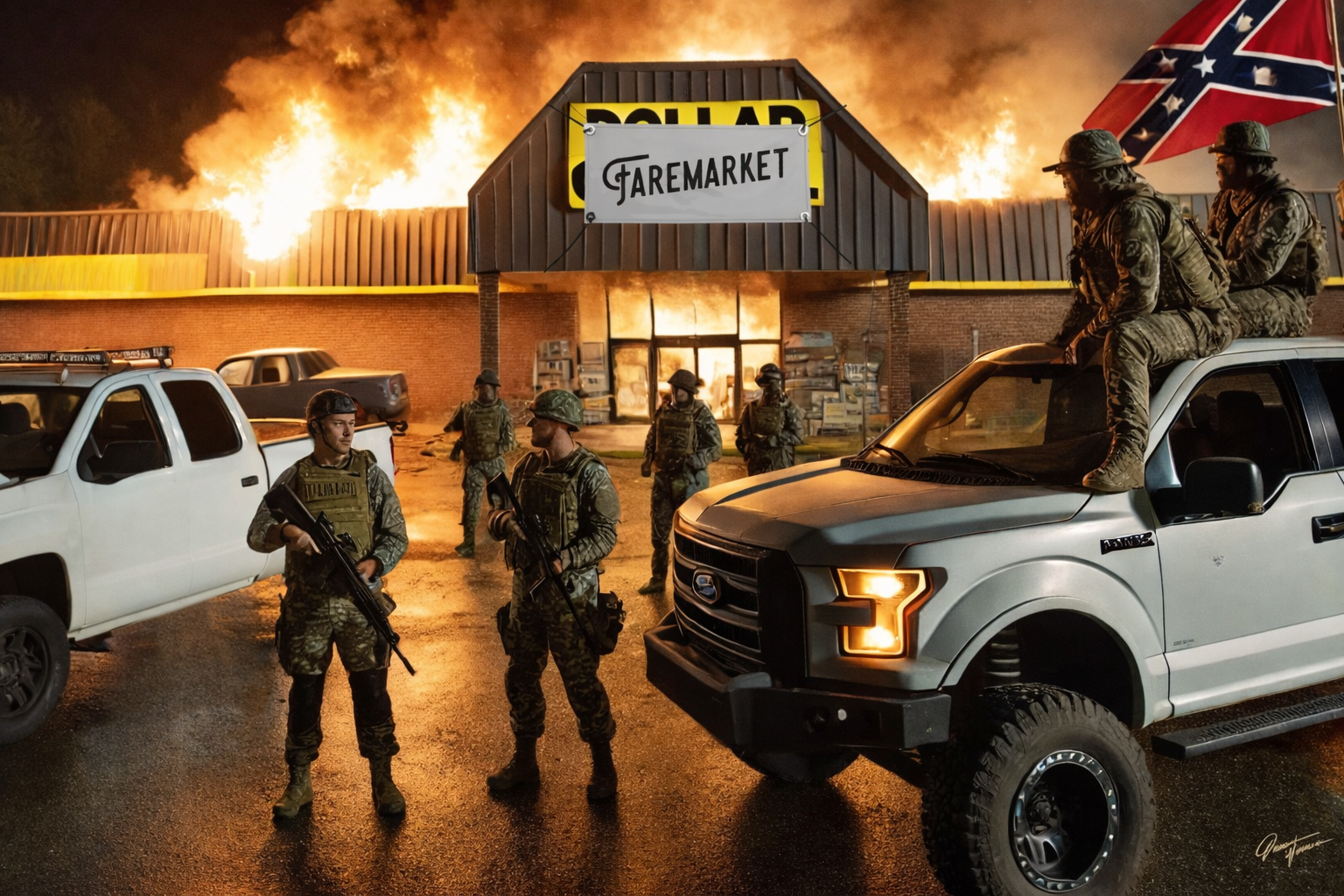
FARE MARKET
Just who is local food for, exactly?
invest in black communities, or die!
The Existential Threat of Inequality
by Benjamin Harrison“The domination of nature by man stems from the very real domination of human by human.” —Murray Bookchin, The Ecology of Freedomnote: FareMarket is a real farm-to-table e-grocery startup in little rock, AR. Black PI’s writer, Benjamin, launched the company in 2020 as the covid pandemic brought society to a screeching halt. Visit FareMarket's online store.Just who is local food for, exactly? Healthy and sustainable products are, by and large, relegated to a niche grocery store aisle or farmers markets in upscale neighborhoods. And they are largely inaccessible in low-income communities. Wealth inequality is the most important barrier to creating a popular local food movement that prioritizes sustainable agriculture and a livable planet. Redlining is the refusal of sales or services to people who reside within a certain geographical area. In underserved communities, this practice involves multiple sectors of the economy. in nature, it is discriminatory practice. It includes anything from lending to healthcare to fresh food. The term, “supermarket redlining” is a real phenomenon present in Little Rock and many other cities. A map of grocery stores in the Little Rock area shows entire swaths of our communities, primarily of color, lack access to fresh food or supermarkets.But it’s not just city folks. This kind of economic exclusion impacts suburban and rural communities too. While local food advocates have been vocal and politically active for more than a century in the U.S., less than 1 percent of today’s food market is locally-sourced. Similarly, organic food is only 5 percent of the total food market. The implications are astounding. 95 percent of all food in the U.S. actively contributes to the deteriorating climate. And 99 percent of all spending on groceries leaves our communities and flows to increasingly wealthy elites, led by Arkansas’ very own grocery tycoon, Alice Walton.In the aftermath of the George Floyd protests in 2020, local protesters barricaded the entrances to three Walmart stores in North Little Rock. Protesters claimed the store’s “always low prices” were in fact subsidized—with taxpayer dollars through low- and no-wage prison wage. This feat is accomplished daily with the sale of products made by prisoners and detainees, through wage slavery. Many of Walmart’s employees also rely on entitlement programs, and Walmart itself is the recipient of numerous corporate tax breaks. THE COMPANY received $285 million in subsidies last year. Much of this came from low-wage workers forced to rely on help from the state to cover groceries at Walmart stores. The agricultural sector’s vast misuse of natural resources, specifically water, compromises all of our futures. Affordability in the modern era may, at face value, appear to be a great equalizer. But it more often is government subsidies for unethical business practices and a terrifying race to the bottom of the barrel in terms of quality.A hundred years ago, nitrogen fertilizer was a game changer for farmers. And it was the primary driver of the modern agricultural revolution. Today, however, farms along the Mississippi River contribute to nitrogen runoff that has created a growing 6,000-square-mile “dead zone” in the Gulf of Mexico, in which marine life cannot survive. From deforestation to the risk of deadly viruses to water pollution and consumer waste, industrialized food production has been environmentally disastrous. Topsoil erosion, antibiotic resistance, and air pollution are just a few of the other side effects of a modern farming system that prioritizes revenue and campaign donors over nature and human life.To its credit, the capitalist model did create the means to overproduce food and other necessities. this could have led to greater ease and liesure for the general public. Paradoxically, the existing economy must reinforce the scarcity it has overcome, through waste, as a strategy to sustain revenues, increase share values, and maintain structures of domination. Consider that $38 million a year worth of Burberry’s unsold clothing sits in landfills. Amazon’s “Destruction Zone” receives 130,000 eliminated, unsold products every week. And 16 million homes in the U.S. are vacant, as cities scratch their heads to come up with solutions for the country’s nearly 800 thousand unhoused PEOPLE.Food waste in the U.S. is contrived and rampant. 30 percent of it never leaves the farm, and another 40 percent, unsold, ends up in landfills. At the same time, 11 million children face food insecurity. Arkansas happens to have the highest rate of childhood hunger, with 1 in 5 children food insecure.Even with the opulence of modernity—the grocery aisles stacked head to toe with brightly-packaged foods—hunger, homelessness, and illness still reign. It does not matter if destroying food can make sense from a legal standpoint. It is immoral.The Food Desert FantasyFood deserts are areas with varying levels of access to fresh food. But putting the focus on food can distract from the full scope of the issue. Food deserts are more aptly described as Sacrifice Zones.Sacrifice Zones are areas that have been intentionally deprived of resources. This label can conveniently provide cover for shifty politicians and business elites. In Louisiana, Cancer Alley is a community impaired by environmental pollution and economic disinvestment. Sacrifice Zones are portions of the economy in which capital leaves and never returns. Housing and health deteriorates, and wages remain too stagnant to sustain grocery stores. These communities are mined for their low-cost labor as chemical companies pull record profits.Little Rock’s air quality isn’t as dire, but many of our neighborhoods meet the definition: economically abandoned, with wealth extracted faster than it can be replaced. A simple search on Google Maps clearly shows areas of Central and Southwest Little Rock, even Capitol View and Stifft Station, lack access to grocery stores, within 1.5 miles. This is particularly problematic for the elderly and those without transportation.It isn’t that the community lacks buying power, just that they have not organized so effectively yet. Food co-ops are a serious alternative and the most successful strategy in many working-class, Black communities, with 95 percent still in operation.Unlike corporate grocery chains, community-owned stores are more likely to hire from within the community, pay livable wages, and find sustainable solutions to food access.Dollar Stores have spread quickly in low-income areas. These small retailers offer slightly smaller versions of name-brand items at prices higher than big-box stores like Walmart. It may seem reasonable, but it provides the illusion of affordability while gouging the most vulnerable.The answer to food deserts—and the broader issue of food insecurity—isn’t to build more supermarkets but to invest in community-owned solutions. Food cooperatives and land trusts can create food systems rooted in the community. That place-baSed aspect ensures profits are reinvested locally and provide a buffer against displacement and gentrification.VISIT FAREMARKET.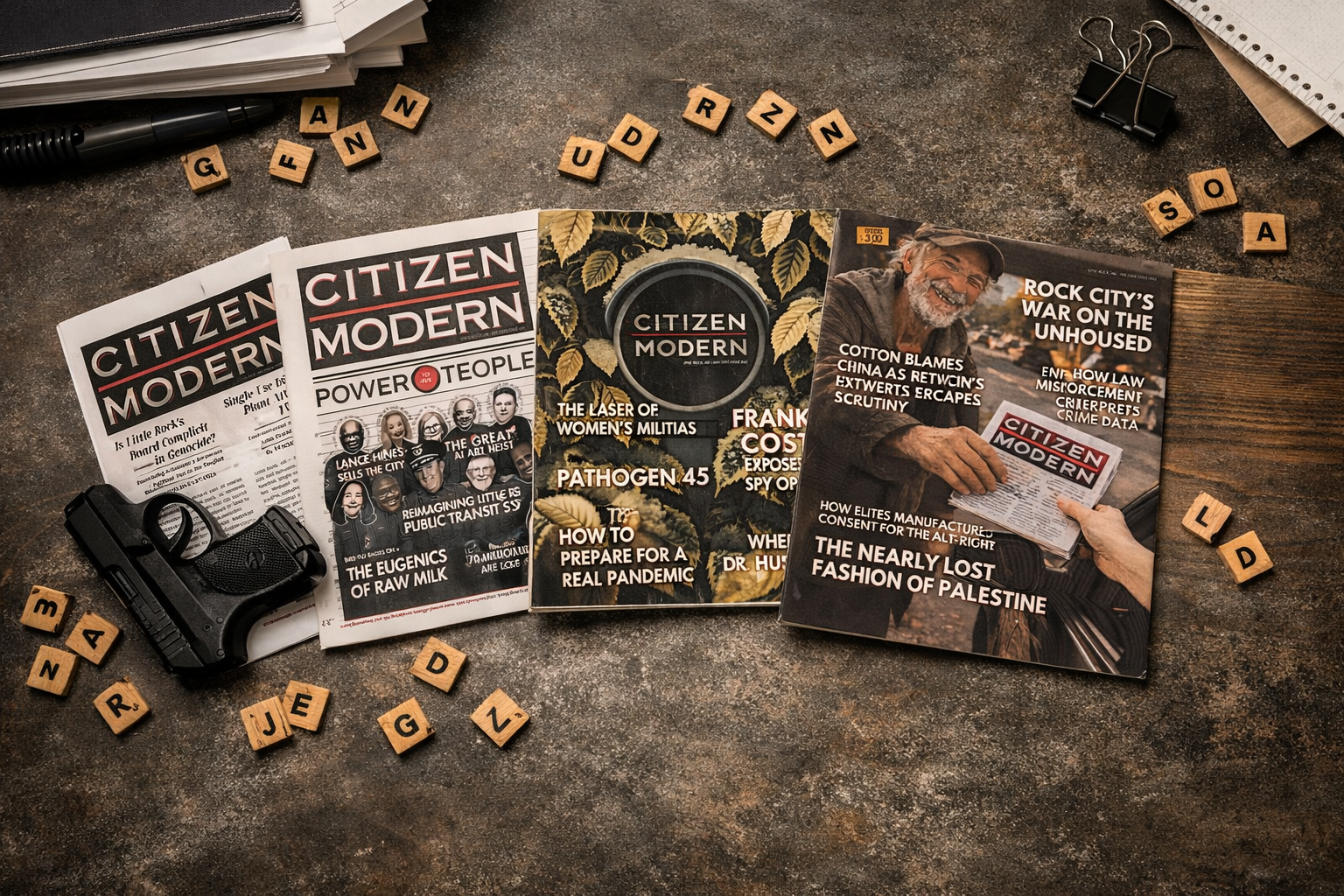
CITIZEN MODERN
Power to the people!
The Arkansas Past Times: A Note from the Editor
Unfortunately, we live in interesting times. And cynicism may sound taboo DUE TO the cliches, but it isn’t the same as being a pessimist.
by benjamin harrison
You hear it often enough—a person disenchanted with the political system shares their skepticism about those in power, and someone hurls out this cliché: “Just don’t become cynical.”I’d say it’s well-meaning, but is it really? Isn’t this phrase, in fact, a way for deluded people to protect themselves from the truth by shaming others out of facing reality?Sometimes, it is well-meaning, if not ignorant. Keep hoping, keep dreaming, just don’t start believing the whole hierarchical power structure is rotten down to its core.Part of this resistance to cynicism is tied to the usual argument: this is the best of all possible systems. And if we don’t have that, what in hell would we do?Cynicism, in this sense, isn’t about giving up on change; it’s about giving up the illusion that someone else will fix things for us. It’s the understanding that no one with power will solve our problems because their interests aren’t the same as ours.Cynicism, then, is the precursor to citizenship. It’s about taking matters into your own hands—working with your community to solve problems yourselves.A city should serve the interests of its citizens, not its elites. And when ordinary people take responsibility for their communities, when they build systems that meet their needs instead of waiting for someone in power to do it for them, that’s when real citizenship begins.In 2019, I went on a date with someone who worked in healthcare research, particularly focused on HIV. I asked if she thought pharmaceutical companies might withhold life-saving drugs if it were more profitable to treat diseases long-term.She confidently assured me that no, these companies would release new drugs as soon as they were available—it was in their best interest.I’ve had many conversations of this nature. Others hold onto the belief that government officials or business leaders have good ethical hygiene, as I consistently question those in power. Unfortunately, I’m usually right.In 2021, it came to light that Gilead Sciences, a pharmaceutical giant, had withheld a safer HIV drug, tenofovir alafenamide (TAF), while continuing to sell an older, more dangerous version, tenofovir disoproxil fumarate (TDF), to maximize profits. This decision put patients at unnecessary risk, all in the name of earnings reports.Experiences like this highlight the necessity of cynicism and have shaped my understanding of politics. They’re why CITIZEN:MODERN exists.Unfortunately, we live in interesting times. And cynicism may sound taboo because of the cliches, but it isn’t the same as being a pessimist. It’s not hopelessness; it’s the knowledge that hoping without clear understanding and subsequent action is mere denial.The modern citizen is, by necessity, a cynical one. Whether it's local leaders pushing for more militarized police and surveillance under the banner of “public safety,” or corporations holding back life-saving medication to meet quarterly goals, we bear witness to the harsh reality of a political system designed to serve the few at the expense of the many.CITIZEN:MODERN exists because we can’t afford to keep trusting this power dynamic. Cynicism is the starting line. It’s not just doubt but a full recognition of the reality we live in—that those with power act in their own interests, and those interests rarely serve the public good.To build a future where our communities—where we—take care of each other and confront climate change and inequality head-on, we must begin with cynicism. We must stop trusting a system that values wealth and status over human lives.I started CITIZEN:MODERN to be a voice for that kind of political realism. And if you’re reading this, I hope you’ll join me. The future depends on it.READ MORE ON OUR SUBSTACK.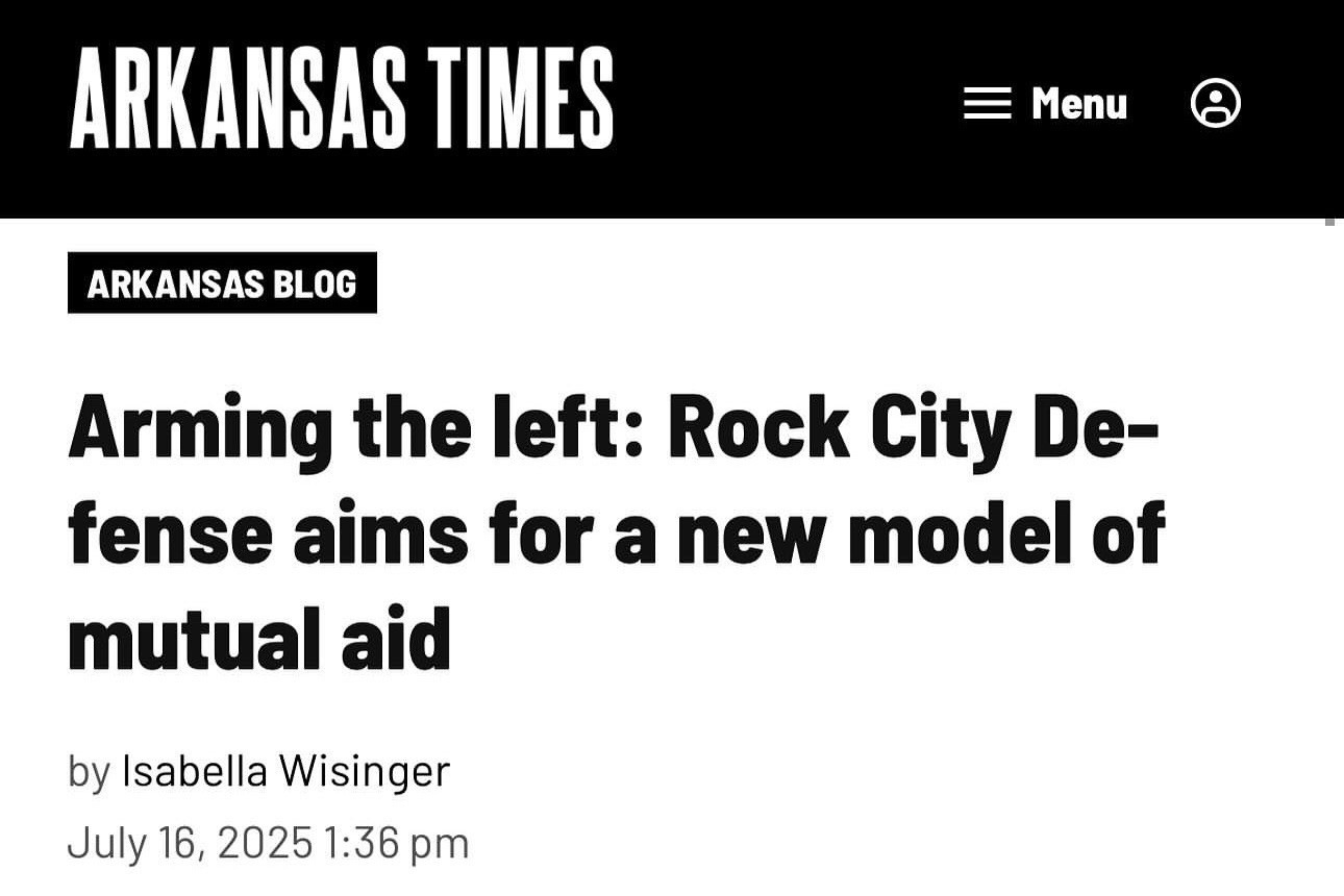
ROCK CITY DEFENSE
Defend the vulnerable ✊🏻✊🏿✊🏽 Strength in solidarity. The more you sweat in training, the less you bleed in combat.
The Case For Women’s Militias
Lessons from the kurdish womens’ movement
by benjamin harrison
I went on a date a few years ago that comes to mind when I think of how charged this topic can get. We ended the evening meeting up with her friend and her friend’s husband, and somehow, the conversation turned to women’s militias as a way to protect women’s rights.I pointed out the overturning of Roe v. Wade despite one of the largest women’s marches in history just a few years earlier. My date’s rebuttal caught me off guard: “I wouldn’t want to have to kill my father.”I was confused, but we were a little drunk at that point, and I tried to clarify that militias aren’t about killing anyone’s family members. Her friend understood the idea and even found it compelling, which sparked an argument with her husband, who opposed the idea of women arming themselves.Later, as the relationship fizzled out, she abruptly mentioned—unprompted—that she didn’t want to join a militia, which struck me as a bit odd but also revealing about the discomfort the subject can provoke.This highlights the range of reactions, both from women and men, to the concept of women’s militias. I’m not here to recruit anyone or dictate what women should do, but I believe it’s important to highlight the strategies women in movements like the kurdish Women’s Protection Units (YPJ) have developed. Applying these lessons to the challenges women face in the U.S. today ties autonomy and defense together in ways worth exploring.The Case For Women’s Militias
Women’s liberation in the West is often viewed as something that can only be achieved within existing political structures. The Kurdish Women’s Movement challenges this notion at its core. in 2014, The Kurdish Revolution in Northern Syria established women’s liberation as the primary tenet of its vision for a democratic society. Unlike many revolutions that have sidelined gender equality as a secondary concern—something to be addressed only after achieving broader social or economic change—the Kurdish Women’s Movement asserts that true social transformation begins by addressing the oppression of women.Abdullah Öcalan, the ideological leader of the Kurdish Freedom Movement, who is currently imprisoned by the Turkish government, articulated this concept with striking clarity.Öcalan argued that women constitute the first “nation” colonized by the patriarchy, and that their relegation to second-class status provided the blueprint for all other forms of domination, from slavery to colonialism.The Kurdish Women’s Movement is not merely an effort to confront immediate threats, such as those posed by the islamic state and al qaeda, but a broader struggle to dismantle structures within Kurdish society that oppress women. This is seen as a moral imperative but also as a strategic necessity for creating a truly free and just society.This framework guides the development of the revolutionary model in Rojava, where women’s councils, neighborhood assemblies, and cooperative economies form the foundation of governance.Women are more than participants in these systems; they are its leaders, shaping policies and practices that prioritize equality, ecological sustainability, and collective autonomy. By centering women’s liberation, the Kurdish revolution redefines what a democratic society can look like. This radical approach challenges deeply entrenched cultural norms.In Rojava (or Kurdistan), women are not secondary, passive actors for change. they are central to the creation of a just society. Kurdish women have reshaped not only the military but also the political system, justice, education, the economy, even beauty standards.This reimagining of values is not a superficial shift but a profound cultural transformation, one that redefines power and challenges the foundations of patriarchy and capitalism alike.The relevance of the Kurdish women’s movement extends far beyond Rojava. In the United States, where women’s rights are consistently under attack, it provides a powerful model for addressing systemic oppression. The overturning of Roe v. Wade, despite one of the largest women’s marches in history in 2017, underscores the limitations of traditional activism and the fragility of rights achieved within existing political structures. By redefining values and reclaiming autonomy, the Kurdish women’s movement demonstrates that liberation requires not just resistance but the creation of entirely new systems.The Kurdish Women’s Militia
The Kurdish women’s movement represents one of the most revolutionary efforts in the world to challenge both external threats and deeply entrenched societal norms. At its heart are the Women’s Protection Units (YPJ), an autonomous, all-female militia that emerged as a critical force in defending Kurdish communities against ISIS and broader patriarchal oppression.Though the YPJ formally came into being in 2013, their roots trace back decades, deeply intertwined with the Kurdish freedom movement, which began in the 1980s as a response to systemic exclusion and oppression by Turkey and Syria.For decades, Kurdish women mobilized to challenge patriarchal systems within their communities, as well as the external forces that sought to suppress Kurdish autonomy. This long history of struggle shaped the ideological foundation for the YPJ, which took on a critical role as ISIS rose to power.The atrocities committed by ISIS—particularly the 2014 massacre in Sinjar, where thousands of Yazidi women were killed or enslaved—underscored the urgent need for women to take up arms to protect themselves and their communities. However, the YPJ’s mission extended far beyond defense; it became a symbol of women’s liberation and a force for societal transformation.The rise of the YPJ drew significant international attention, but much of the Western portrayal of these women was reductive, focusing on their appearance and novelty as women soldiers rather than their values and the systems they were building. Western media often fetishized the YPJ, casting them as exoticized symbols of defiance while ignoring the decades of ideological work that laid the foundation for their fight.This portrayal was further complicated by the geopolitical context: the U.S., whose military interventions in Iraq and Afghanistan destabilized the region and created the conditions for ISIS’s rise, suddenly found itself allied with the Kurds against ISIS.While the U.S. celebrated the YPJ’s successes on the battlefield, it simultaneously maintained its alliance with Turkey, which continued to wage war against Kurdish autonomy. This contradiction reveals the limits of the Western lens. By tokenizing Kurdish women as fascinating soldiers, Western narratives obscured the profound values that underpinned their struggle.The Kurdish women’s movement was not simply a reaction to ISIS; it was part of a broader effort to dismantle patriarchy and build a radically democratic society. At the core of this movement were women’s councils, community assemblies, and cooperatives.One of the most striking aspects of the Kurdish women’s movement is its redefinition of beauty. In Rojava, beauty is not only tied to physical appearance or superficial aesthetics, as it often is in the West. Instead, beauty is rooted in values like justice, liberation, and autonomy. A woman is considered beautiful for her actions: defending her community, creating systems of equality and freedom, mentoring and educating other women, and protecting the environment.This concept challenges Western objectification of women’s bodies, including the fetishized imagery of Kurdish women as soldiers. it reframes beauty as a reflection of ethics and contributions to collective well-being.The YPJ’s dual role (defending against external threats while protecting the autonomous structures women were building) highlights the depth of their struggle. These women did not just fight ISIS. they safeguarded a vision for a society, rooted in justice and equality. They defended cooperatives that produced goods like bread and textiles, mutual aid networks that ensured access to food and healthcare, and women’s councils that democratized governance.
These systems embodied the values of the Kurdish freedom movement. they offer an alternative to the exploitation and oppression perpetuated by both patriarchal and encroaching neoliberal capitalist systems.Through their militias, councils, and cooperative structures, Kurdish women built a model of resilience and empowerment that transcends conventional notions of defense. Their fight is not just a military one but an ideological and cultural struggle to redefine what is possible for women and society as a whole.By protecting what they have built, the YPJ demonstrates that liberation is not only about resisting oppression but also about creating systems that reflect the principles of justice, autonomy, and solidarity.American Parallels: The Need for Defensive Organization
In the United States, women’s rights face troubling rollbacks with the overturning of Roe v. Wade in 2022 serving as a watershed moment. This decision marked the end of nearly fifty years of federally protected reproductive rights, exposing the fragility of hard-won freedoms.Even in the face of unprecedented mobilizations like the 2017 Women’s March (one of the largest protests in U.S. history) the erosion of women’s rights continues. These events raise pressing questions about the effectiveness of traditional forms of activism and the need for more robust strategies to protect women’s rights.The failure of men and the state to protect women extends far beyond reproductive rights. Systemic issues disproportionately affect marginalized groups, including women of color and trans women.for example, Black women and girls make up an exceptional percentage of missing person cases in the U.S. evidence shows their cases are often deprioritized by law enforcement and underrepresented in media coverage.According to the Black and Missing Foundation, persons of color account for nearly 40% of all missing persons in the U.S., despite making up only 13 percent of the population. This reflects both higher rates of disappearance among marginalized communities and systemic neglect in addressing these cases.Similarly, trans women, particularly Black and Latina trans women, face alarmingly high rates of violence. In 2023 alone, at least 30 transgender women were murdered in the U.S., an alarming figure considering their relatively small population.Additionally, the systemic neglect of crimes against women is epitomized by the backlog of untested rape kits in police departments across the country. In cities like Houston and Memphis, thousands of kits have gone unprocessed for decades, leaving survivors without justice and perpetrators free to harm others.This negligence underscores the unwillingness of the state to prioritize women’s safety. These failures echo Abdullah Öcalan’s critique of capitalism and patriarchy, which he argued are intertwined systems that foster passivity and dependency.Just as women in patriarchal societies are often relegated to subservient roles, capitalism reduces individuals to consumers and workers who rely on exploitative systems for survival.In the U.S., the relationship between the state and society mirrors what could be described as a codependent dynamic. the state offers the illusion of care while consolidating power and maintaining control. This dynamic leaves women most vulnerable to both structural injustices and direct violence.The Kurdish women’s movement offers a stark contrast. In Rojava, women have taken control of their own safety and governance, creating systems that prioritize equity and autonomy.The Women’s Protection Units (YPJ) serve as a powerful deterrent against external threats, while women’s councils ensure that women have a voice in decision-making processes at every level. A similar approach in the U.S. could address the gaps left by failed traditional institutions.Defensive organization, such as women’s militias, would provide a means of protecting against violence while building solidarity and community-based networks. These militias could act as both a deterrent to systemic injustices and a foundation for broader societal transformation. By prioritizing cooperatives, education, and self-defense, such efforts would empower women to challenge the systems that have failed them and to reclaim their autonomy.The challenges faced by women in the U.S. today (whether the erosion of reproductive rights, systemic neglect, or rising violence) demand more than incremental reforms. They require bold, community-driven solutions that address the root causes of oppression.Drawing from the Kurdish model, defensive organization offers a way to protect not only individual women but also the principles of equality and justice that are essential for a free society.Potential Objectives & Structure of a Women’s Militia in the U.S.
The Kurdish women’s movement offers a revolutionary model for addressing systemic injustices and building community resilience. Its strategies for empowerment, self-defense, and self- governance provide valuable lessons for women’s militias in the United States.By addressing immediate safety concerns and fostering long-term resilience, these militias could fill the gaps left by failed institutions and protect women’s autonomy in the face of systemic neglect.In Rojava, the formation of the Women’s Protection Units (YPJ) sent a powerful message to both external aggressors, like ISIS, and internal patriarchal structures: women would no longer passively endure violence. The presence of armed women defending their rights and their communities reshaped the balance of power, challenging long-standing assumptions about women’s roles.Similarly, in the U.S., organized women’s militias could act as a deterrent against gender-based violence as well as oppressive legislation, demonstrating that women are prepared to defend their freedom and their lives.These militias could also foster community empowerment by establishing cooperatives and mutual aid networks to address essential survival needs such as food, healthcare, and shelter. In Rojava, women’s councils organized cooperatives to produce bread, clothing, and other goods, ensuring that communities remained self-sufficient, even in times of crisis.These cooperatives reduced reliance on external aid and empowered women as economic contributors and decision-makers. Educational programs that teach self-defense, legal literacy, and community organizing could further equip women with the tools to protect themselves and advocate for systemic change.Together, these efforts would not only address immediate needs but also build the foundations for greater autonomy and resilience. One of the most striking aspects of the Kurdish women’s movement is its creation of separate women’s court systems to address crimes of violence against women.Early in the movement, as attacks against women increased in response to their rising visibility and power, these courts provided a crucial means of justice. By inflicting harsher punishments for violent crimes perpetrated by men against women, the courts sent a clear message that gender-based violence would not be tolerated.In the U.S., where systemic failures in law enforcement and the judiciary often leave survivors of violence without recourse, a similar model could offer transformative potential.Women’s militias could organize investigative teams to assist in locating missing women, documenting cases of violence, and advocating for justice in instances of police neglect or bias. These efforts would amplify the voices of marginalized women and hold institutions accountable for systemic inequities.The Kurdish women’s movement also emphasizes the importance of women’s leadership in creating an equitable and just society. In Rojava, women hold equal leadership positions in councils and assemblies, ensuring their voices are integral to governance. This approach not only gives women a platform to influence decision-making but also establishes them as creators of their society, redefining what leadership looks like.In the U.S., a similar emphasis on women’s leadership could open opportunities for women to shape their communities and lead initiatives that prioritize equity and sustainability. Women-led cooperatives and councils could foster economic independence and self-reliance, creating a framework for resilience in the face of systemic challenges.By combining deterrence, community empowerment, investigative efforts, and leadership development, women’s militias could address the systemic injustices that have left them vulnerable while fostering solidarity and resilience.Inspired by the Kurdish model, such organizations could offer a transformative response to the challenges faced by women in the United States, ensuring that women are not only protected but empowered to lead the way toward a more equitable future.The Kurdish Women’s Protection Units (YPJ) exemplify a defensive force dedicated to safeguarding their communities and the autonomous structures they have painstakingly developed. Their mission is not to initiate conflict but to protect against external aggressors and uphold the self- governance systems that empower women at the grassroots level.This defensive posture is crucial in preserving initiatives such as women-owned cooperatives and communal support networks that ensure equitable access to resources like food and healthcare.In protecting these systems, the YPJ also safeguards the right of women to be creators of their societies, contributing to a model of justice and resilience that transcends traditional hierarchies.A historical parallel can be drawn with the Black Panther Party’s Free Breakfast for Children Program in the United States. Established in 1969, this initiative provided free meals to thousands of children in underserved communities, directly addressing food insecurity and systemic neglect. The success of the program in fostering community autonomy and solidarity was so impactful that fbi director J. Edgar Hoover described it as “potentially the greatest threat to efforts by authorities to neutralize the Black Panther Party and destroy what it stands for.”Such community-driven efforts challenged existing power structures by demonstrating that marginalized groups could care for their own without state intervention. In response, federal initiatives like the expansion of the USDA’s school breakfast program sought to reassert governmental control over social welfare.Both the Kurdish women’s movement and the Black Panther Party illustrate the transformative power of community-led initiatives. They show that defending the structures that support autonomy—whether they are cooperatives, communal systems of resource distribution, or grassroots political decision-making—is a necessary act of resistance.These organizations are not aggressors but protectors of their communities, redefining what it means to struggle for freedom. By defending their right to self-determination, they build pathways to a more just and equitable society.As women in the United States face increasing threats to their rights and autonomy, these examples hold powerful lessons. Defensive organization does more than address immediate concerns—it lays the groundwork for a movement that challenges systemic oppression at its core. It creates space for women to lead, to innovate, and to shape their societies in ways that reflect their values and priorities. Through cooperatives, self-defense, and solidarity, such movements can reclaim the autonomy that oppressive systems seek to erode. The struggle for women’s liberation is not just a fight for equality. it is the defining struggle of our time. Abdullah Öcalan theorized that the 19th century was the century of bourgeois revolutions, that the 20th century was the century of workers’ revolutions, but that the 21st century will be the century of women’s revolutions.The transformative potential of women’s movements lies not only in what they resist but in what they create: systems that prioritize justice, equity, and freedom. A century of women’s revolutions is already underway, and it will shape humanity’s future.Visit Rock City Defense on Instagram.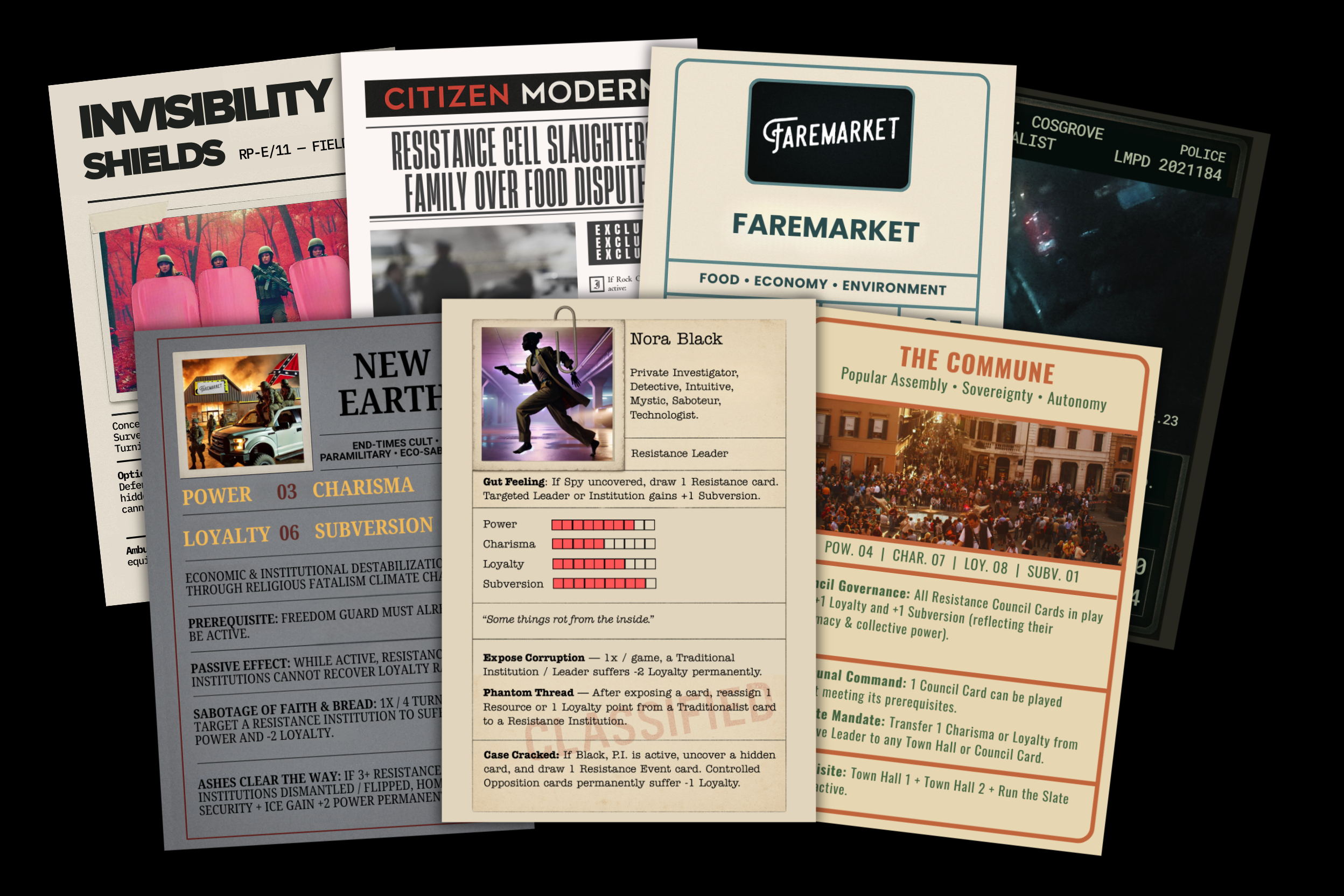
BLACK PI CARD GAME
Power, legitimacy, collapse. A revolutionary RPG.
BLACK PI: THE CARD GAME IS A non-traditional role playing POLITICAL STRATEGY GAME ABOUT POWER, PROPAGANDA, AND POPULAR CONTROL. POWER MOVES QUIETLY, UNEVENLY, AND OFTEN BEHIND RESPECTABLE INSTITUTIONS. IT’S LESS ABOUT HEROES AND VILLAINS THAN SYSTEMS, CORRUPTION, AND THE FRAGILE LINE BETWEEN DEMOCRACY AND DOMINATION.PLAYERS TAKE ON ASYMMETRIC ROLES. THE RESISTANCE BUILDS ALTERNATIVE ECONOMIES, ESTABLISHES MILITIAS, GRASSROOTS MEDIA, RUNS RECALLABLE CANDIDATES FOR LOCAL OFFICE, AND EXPANDS ITS CONFEDERATION OF COMMUNITY ASSEMBLIES.TRADITIONALIST POWER, ON THE OTHER HAND, EXPANDS ITS SURVEILLANCE NETWORK AND ABSORBS RIGHT-WING PARAMILITARIES INTO ITS LAW ENFORCEMENT AND MILITARY APPARATUS. PROPAGANDA NETWORKS, CORPORATE CAPTURE, AND STATE REPRESSION FORM A TRIFECTA THAT UNDERMINES ANY MOVEMENT THAT MIGHT THREATEN THEIR ABSOLUTE CONTROL OVER SOCIETY.VICTORY WON’T COME FROM RAW FORCE ALONE. IT WILL REQUIRE FORMING LEGITIMACY, FOSTERING LOYALTY, AND CONTROLLING THE NARRATIVE. WHAT MAKES THIS GAME DIFFERENT IS ITS EMPHASIS ON INTERACTION OVER ABSTRACTION. CARDS DON’T JUST ADD OR SUBTRACT NUMBERS. THEY START—OR END—REVOLUTIONS.A MOLE EMBEDDED IN A MEDIA INSTITUTION CAN FRACTURE TRUST OVER MULTIPLE TURNS. A RECALL MECHANISM CAN NEUTRALIZE ELITE CAPTURE. BUT ONLY IF POPULAR STRUCTURES ARE ALREADY IN PLACE. THE LONGER SURVEILLANCE NETWORKS GO UNCHALLENGED, THE MORE DANGEROUS THEY BECOME.PARAMILITARIES AND DEPUTY GANGS CONSOLIDATE POWER EARLY AND BECOME LIABILITIES LATER. NOTHING IS STATIC. THE GAME UNFOLDS IN PHASES THAT MIRROR REAL POLITICAL DYNAMICS. EARLY ROUNDS ARE UNSTABLE. STREET MOVEMENTS, FRAGMENTED INSTITUTIONS, OPPORTUNISTS.MIDGAME, DUAL POWER DEVELOPs as ASSEMBLIES COUNTER STATE power. MUTUAL AID AND COOPERATIVES NULLIFY AUSTERITY. legitimacy faces off with coercion. the latter portion is about consolidating or facing collapse. either the resistance institutionalizes popular sovereignty, or the regime hardens into something far more difficult to dislodge.importantly, the game avoids overly simplistic moral binaries. repression can backfire, exposure might fracture social movements, and charisma devoid of accountability is a threat to either side.every mechanic is designed to force players to confront tradeoffs instead of chase an optimal path. at its core, black pi: the card game asks a series of crucial questions: what is power? and what holds it together? and what causes it to unravel?like the show, the game blends real world startups, organizations, and movements. it’s a simulation until it isn’t. but it’s also a lens to understand social and political life in 2026. once you see the system, you can’t unsee it.