

FARE MARKET
Just who is local food for, exactly?
invest in black communities, or die!
The Existential Threat of Inequality
by Benjamin Harrison“The domination of nature by man stems from the very real domination of human by human.” —Murray Bookchin, The Ecology of Freedomnote: FareMarket is a real farm-to-table e-grocery startup in little rock, AR. Black PI’s writer, Benjamin, launched the company in 2020 as the covid pandemic brought society to a screeching halt. Visit FareMarket's online store.Just who is local food for, exactly? Healthy and sustainable products are, by and large, relegated to a niche grocery store aisle or farmers markets in upscale neighborhoods. And they are largely inaccessible in low-income communities. Wealth inequality is the most important barrier to creating a popular local food movement that prioritizes sustainable agriculture and a livable planet. Redlining is the refusal of sales or services to people who reside within a certain geographical area. In underserved communities, this practice involves multiple sectors of the economy. in nature, it is discriminatory practice. It includes anything from lending to healthcare to fresh food. The term, “supermarket redlining” is a real phenomenon present in Little Rock and many other cities. A map of grocery stores in the Little Rock area shows entire swaths of our communities, primarily of color, lack access to fresh food or supermarkets.But it’s not just city folks. This kind of economic exclusion impacts suburban and rural communities too. While local food advocates have been vocal and politically active for more than a century in the U.S., less than 1 percent of today’s food market is locally-sourced. Similarly, organic food is only 5 percent of the total food market. The implications are astounding. 95 percent of all food in the U.S. actively contributes to the deteriorating climate. And 99 percent of all spending on groceries leaves our communities and flows to increasingly wealthy elites, led by Arkansas’ very own grocery tycoon, Alice Walton.In the aftermath of the George Floyd protests in 2020, local protesters barricaded the entrances to three Walmart stores in North Little Rock. Protesters claimed the store’s “always low prices” were in fact subsidized—with taxpayer dollars through low- and no-wage prison wage. This feat is accomplished daily with the sale of products made by prisoners and detainees, through wage slavery. Many of Walmart’s employees also rely on entitlement programs, and Walmart itself is the recipient of numerous corporate tax breaks. THE COMPANY received $285 million in subsidies last year. Much of this came from low-wage workers forced to rely on help from the state to cover groceries at Walmart stores. The agricultural sector’s vast misuse of natural resources, specifically water, compromises all of our futures. Affordability in the modern era may, at face value, appear to be a great equalizer. But it more often is government subsidies for unethical business practices and a terrifying race to the bottom of the barrel in terms of quality.A hundred years ago, nitrogen fertilizer was a game changer for farmers. And it was the primary driver of the modern agricultural revolution. Today, however, farms along the Mississippi River contribute to nitrogen runoff that has created a growing 6,000-square-mile “dead zone” in the Gulf of Mexico, in which marine life cannot survive. From deforestation to the risk of deadly viruses to water pollution and consumer waste, industrialized food production has been environmentally disastrous. Topsoil erosion, antibiotic resistance, and air pollution are just a few of the other side effects of a modern farming system that prioritizes revenue and campaign donors over nature and human life.To its credit, the capitalist model did create the means to overproduce food and other necessities. this could have led to greater ease and liesure for the general public. Paradoxically, the existing economy must reinforce the scarcity it has overcome, through waste, as a strategy to sustain revenues, increase share values, and maintain structures of domination. Consider that $38 million a year worth of Burberry’s unsold clothing sits in landfills. Amazon’s “Destruction Zone” receives 130,000 eliminated, unsold products every week. And 16 million homes in the U.S. are vacant, as cities scratch their heads to come up with solutions for the country’s nearly 800 thousand unhoused PEOPLE.Food waste in the U.S. is contrived and rampant. 30 percent of it never leaves the farm, and another 40 percent, unsold, ends up in landfills. At the same time, 11 million children face food insecurity. Arkansas happens to have the highest rate of childhood hunger, with 1 in 5 children food insecure.Even with the opulence of modernity—the grocery aisles stacked head to toe with brightly-packaged foods—hunger, homelessness, and illness still reign. It does not matter if destroying food can make sense from a legal standpoint. It is immoral.The Food Desert FantasyFood deserts are areas with varying levels of access to fresh food. But putting the focus on food can distract from the full scope of the issue. Food deserts are more aptly described as Sacrifice Zones.Sacrifice Zones are areas that have been intentionally deprived of resources. This label can conveniently provide cover for shifty politicians and business elites. In Louisiana, Cancer Alley is a community impaired by environmental pollution and economic disinvestment. Sacrifice Zones are portions of the economy in which capital leaves and never returns. Housing and health deteriorates, and wages remain too stagnant to sustain grocery stores. These communities are mined for their low-cost labor as chemical companies pull record profits.Little Rock’s air quality isn’t as dire, but many of our neighborhoods meet the definition: economically abandoned, with wealth extracted faster than it can be replaced. A simple search on Google Maps clearly shows areas of Central and Southwest Little Rock, even Capitol View and Stifft Station, lack access to grocery stores, within 1.5 miles. This is particularly problematic for the elderly and those without transportation.It isn’t that the community lacks buying power, just that they have not organized so effectively yet. Food co-ops are a serious alternative and the most successful strategy in many working-class, Black communities, with 95 percent still in operation.Unlike corporate grocery chains, community-owned stores are more likely to hire from within the community, pay livable wages, and find sustainable solutions to food access.Dollar Stores have spread quickly in low-income areas. These small retailers offer slightly smaller versions of name-brand items at prices higher than big-box stores like Walmart. It may seem reasonable, but it provides the illusion of affordability while gouging the most vulnerable.The answer to food deserts—and the broader issue of food insecurity—isn’t to build more supermarkets but to invest in community-owned solutions. Food cooperatives and land trusts can create food systems rooted in the community. That place-baSed aspect ensures profits are reinvested locally and provide a buffer against displacement and gentrification.VISIT FAREMARKET.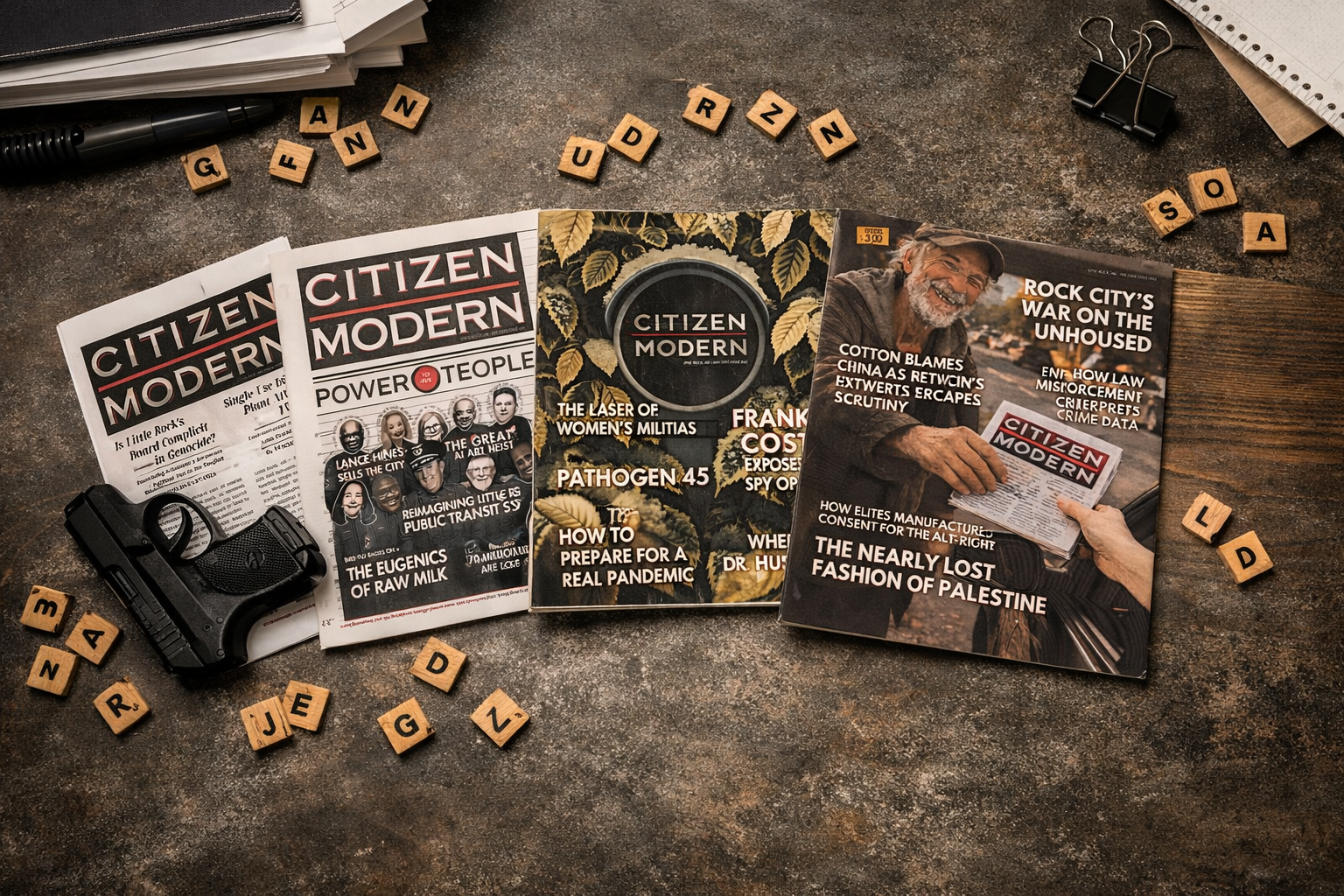
CITIZEN MODERN
Power to the people!
The Arkansas Past Times: A Note from the Editor
Unfortunately, we live in interesting times. And cynicism may sound taboo DUE TO the cliches, but it isn’t the same as being a pessimist.
by benjamin harrison
You hear it often enough—a person disenchanted with the political system shares their skepticism about those in power, and someone hurls out this cliché: “Just don’t become cynical.”I’d say it’s well-meaning, but is it really? Isn’t this phrase, in fact, a way for deluded people to protect themselves from the truth by shaming others out of facing reality?Sometimes, it is well-meaning, if not ignorant. Keep hoping, keep dreaming, just don’t start believing the whole hierarchical power structure is rotten down to its core.Part of this resistance to cynicism is tied to the usual argument: this is the best of all possible systems. And if we don’t have that, what in hell would we do?Cynicism, in this sense, isn’t about giving up on change; it’s about giving up the illusion that someone else will fix things for us. It’s the understanding that no one with power will solve our problems because their interests aren’t the same as ours.Cynicism, then, is the precursor to citizenship. It’s about taking matters into your own hands—working with your community to solve problems yourselves.A city should serve the interests of its citizens, not its elites. And when ordinary people take responsibility for their communities, when they build systems that meet their needs instead of waiting for someone in power to do it for them, that’s when real citizenship begins.In 2019, I went on a date with someone who worked in healthcare research, particularly focused on HIV. I asked if she thought pharmaceutical companies might withhold life-saving drugs if it were more profitable to treat diseases long-term.She confidently assured me that no, these companies would release new drugs as soon as they were available—it was in their best interest.I’ve had many conversations of this nature. Others hold onto the belief that government officials or business leaders have good ethical hygiene, as I consistently question those in power. Unfortunately, I’m usually right.In 2021, it came to light that Gilead Sciences, a pharmaceutical giant, had withheld a safer HIV drug, tenofovir alafenamide (TAF), while continuing to sell an older, more dangerous version, tenofovir disoproxil fumarate (TDF), to maximize profits. This decision put patients at unnecessary risk, all in the name of earnings reports.Experiences like this highlight the necessity of cynicism and have shaped my understanding of politics. They’re why CITIZEN:MODERN exists.Unfortunately, we live in interesting times. And cynicism may sound taboo because of the cliches, but it isn’t the same as being a pessimist. It’s not hopelessness; it’s the knowledge that hoping without clear understanding and subsequent action is mere denial.The modern citizen is, by necessity, a cynical one. Whether it's local leaders pushing for more militarized police and surveillance under the banner of “public safety,” or corporations holding back life-saving medication to meet quarterly goals, we bear witness to the harsh reality of a political system designed to serve the few at the expense of the many.CITIZEN:MODERN exists because we can’t afford to keep trusting this power dynamic. Cynicism is the starting line. It’s not just doubt but a full recognition of the reality we live in—that those with power act in their own interests, and those interests rarely serve the public good.To build a future where our communities—where we—take care of each other and confront climate change and inequality head-on, we must begin with cynicism. We must stop trusting a system that values wealth and status over human lives.I started CITIZEN:MODERN to be a voice for that kind of political realism. And if you’re reading this, I hope you’ll join me. The future depends on it.READ MORE ON OUR SUBSTACK.
ROCK CITY DEFENSE
Defend the vulnerable ✊🏻✊🏿✊🏽 Strength in solidarity. The more you sweat in training, the less you bleed in combat.
The Case For Women’s Militias
Lessons from the kurdish womens’ movement
by benjamin harrison
I went on a date a few years ago that comes to mind when I think of how charged this topic can get. We ended the evening meeting up with her friend and her friend’s husband, and somehow, the conversation turned to women’s militias as a way to protect women’s rights.I pointed out the overturning of Roe v. Wade despite one of the largest women’s marches in history just a few years earlier. My date’s rebuttal caught me off guard: “I wouldn’t want to have to kill my father.”I was confused, but we were a little drunk at that point, and I tried to clarify that militias aren’t about killing anyone’s family members. Her friend understood the idea and even found it compelling, which sparked an argument with her husband, who opposed the idea of women arming themselves.Later, as the relationship fizzled out, she abruptly mentioned—unprompted—that she didn’t want to join a militia, which struck me as a bit odd but also revealing about the discomfort the subject can provoke.This highlights the range of reactions, both from women and men, to the concept of women’s militias. I’m not here to recruit anyone or dictate what women should do, but I believe it’s important to highlight the strategies women in movements like the kurdish Women’s Protection Units (YPJ) have developed. Applying these lessons to the challenges women face in the U.S. today ties autonomy and defense together in ways worth exploring.The Case For Women’s Militias
Women’s liberation in the West is often viewed as something that can only be achieved within existing political structures. The Kurdish Women’s Movement challenges this notion at its core. in 2014, The Kurdish Revolution in Northern Syria established women’s liberation as the primary tenet of its vision for a democratic society. Unlike many revolutions that have sidelined gender equality as a secondary concern—something to be addressed only after achieving broader social or economic change—the Kurdish Women’s Movement asserts that true social transformation begins by addressing the oppression of women.Abdullah Öcalan, the ideological leader of the Kurdish Freedom Movement, who is currently imprisoned by the Turkish government, articulated this concept with striking clarity.Öcalan argued that women constitute the first “nation” colonized by the patriarchy, and that their relegation to second-class status provided the blueprint for all other forms of domination, from slavery to colonialism.The Kurdish Women’s Movement is not merely an effort to confront immediate threats, such as those posed by the islamic state and al qaeda, but a broader struggle to dismantle structures within Kurdish society that oppress women. This is seen as a moral imperative but also as a strategic necessity for creating a truly free and just society.This framework guides the development of the revolutionary model in Rojava, where women’s councils, neighborhood assemblies, and cooperative economies form the foundation of governance.Women are more than participants in these systems; they are its leaders, shaping policies and practices that prioritize equality, ecological sustainability, and collective autonomy. By centering women’s liberation, the Kurdish revolution redefines what a democratic society can look like. This radical approach challenges deeply entrenched cultural norms.In Rojava (or Kurdistan), women are not secondary, passive actors for change. they are central to the creation of a just society. Kurdish women have reshaped not only the military but also the political system, justice, education, the economy, even beauty standards.This reimagining of values is not a superficial shift but a profound cultural transformation, one that redefines power and challenges the foundations of patriarchy and capitalism alike.The relevance of the Kurdish women’s movement extends far beyond Rojava. In the United States, where women’s rights are consistently under attack, it provides a powerful model for addressing systemic oppression. The overturning of Roe v. Wade, despite one of the largest women’s marches in history in 2017, underscores the limitations of traditional activism and the fragility of rights achieved within existing political structures. By redefining values and reclaiming autonomy, the Kurdish women’s movement demonstrates that liberation requires not just resistance but the creation of entirely new systems.The Kurdish Women’s Militia
The Kurdish women’s movement represents one of the most revolutionary efforts in the world to challenge both external threats and deeply entrenched societal norms. At its heart are the Women’s Protection Units (YPJ), an autonomous, all-female militia that emerged as a critical force in defending Kurdish communities against ISIS and broader patriarchal oppression.Though the YPJ formally came into being in 2013, their roots trace back decades, deeply intertwined with the Kurdish freedom movement, which began in the 1980s as a response to systemic exclusion and oppression by Turkey and Syria.For decades, Kurdish women mobilized to challenge patriarchal systems within their communities, as well as the external forces that sought to suppress Kurdish autonomy. This long history of struggle shaped the ideological foundation for the YPJ, which took on a critical role as ISIS rose to power.The atrocities committed by ISIS—particularly the 2014 massacre in Sinjar, where thousands of Yazidi women were killed or enslaved—underscored the urgent need for women to take up arms to protect themselves and their communities. However, the YPJ’s mission extended far beyond defense; it became a symbol of women’s liberation and a force for societal transformation.The rise of the YPJ drew significant international attention, but much of the Western portrayal of these women was reductive, focusing on their appearance and novelty as women soldiers rather than their values and the systems they were building. Western media often fetishized the YPJ, casting them as exoticized symbols of defiance while ignoring the decades of ideological work that laid the foundation for their fight.This portrayal was further complicated by the geopolitical context: the U.S., whose military interventions in Iraq and Afghanistan destabilized the region and created the conditions for ISIS’s rise, suddenly found itself allied with the Kurds against ISIS.While the U.S. celebrated the YPJ’s successes on the battlefield, it simultaneously maintained its alliance with Turkey, which continued to wage war against Kurdish autonomy. This contradiction reveals the limits of the Western lens. By tokenizing Kurdish women as fascinating soldiers, Western narratives obscured the profound values that underpinned their struggle.The Kurdish women’s movement was not simply a reaction to ISIS; it was part of a broader effort to dismantle patriarchy and build a radically democratic society. At the core of this movement were women’s councils, community assemblies, and cooperatives.One of the most striking aspects of the Kurdish women’s movement is its redefinition of beauty. In Rojava, beauty is not only tied to physical appearance or superficial aesthetics, as it often is in the West. Instead, beauty is rooted in values like justice, liberation, and autonomy. A woman is considered beautiful for her actions: defending her community, creating systems of equality and freedom, mentoring and educating other women, and protecting the environment.This concept challenges Western objectification of women’s bodies, including the fetishized imagery of Kurdish women as soldiers. it reframes beauty as a reflection of ethics and contributions to collective well-being.The YPJ’s dual role (defending against external threats while protecting the autonomous structures women were building) highlights the depth of their struggle. These women did not just fight ISIS. they safeguarded a vision for a society, rooted in justice and equality. They defended cooperatives that produced goods like bread and textiles, mutual aid networks that ensured access to food and healthcare, and women’s councils that democratized governance.
These systems embodied the values of the Kurdish freedom movement. they offer an alternative to the exploitation and oppression perpetuated by both patriarchal and encroaching neoliberal capitalist systems.Through their militias, councils, and cooperative structures, Kurdish women built a model of resilience and empowerment that transcends conventional notions of defense. Their fight is not just a military one but an ideological and cultural struggle to redefine what is possible for women and society as a whole.By protecting what they have built, the YPJ demonstrates that liberation is not only about resisting oppression but also about creating systems that reflect the principles of justice, autonomy, and solidarity.American Parallels: The Need for Defensive Organization
In the United States, women’s rights face troubling rollbacks with the overturning of Roe v. Wade in 2022 serving as a watershed moment. This decision marked the end of nearly fifty years of federally protected reproductive rights, exposing the fragility of hard-won freedoms.Even in the face of unprecedented mobilizations like the 2017 Women’s March (one of the largest protests in U.S. history) the erosion of women’s rights continues. These events raise pressing questions about the effectiveness of traditional forms of activism and the need for more robust strategies to protect women’s rights.The failure of men and the state to protect women extends far beyond reproductive rights. Systemic issues disproportionately affect marginalized groups, including women of color and trans women.for example, Black women and girls make up an exceptional percentage of missing person cases in the U.S. evidence shows their cases are often deprioritized by law enforcement and underrepresented in media coverage.According to the Black and Missing Foundation, persons of color account for nearly 40% of all missing persons in the U.S., despite making up only 13 percent of the population. This reflects both higher rates of disappearance among marginalized communities and systemic neglect in addressing these cases.Similarly, trans women, particularly Black and Latina trans women, face alarmingly high rates of violence. In 2023 alone, at least 30 transgender women were murdered in the U.S., an alarming figure considering their relatively small population.Additionally, the systemic neglect of crimes against women is epitomized by the backlog of untested rape kits in police departments across the country. In cities like Houston and Memphis, thousands of kits have gone unprocessed for decades, leaving survivors without justice and perpetrators free to harm others.This negligence underscores the unwillingness of the state to prioritize women’s safety. These failures echo Abdullah Öcalan’s critique of capitalism and patriarchy, which he argued are intertwined systems that foster passivity and dependency.Just as women in patriarchal societies are often relegated to subservient roles, capitalism reduces individuals to consumers and workers who rely on exploitative systems for survival.In the U.S., the relationship between the state and society mirrors what could be described as a codependent dynamic. the state offers the illusion of care while consolidating power and maintaining control. This dynamic leaves women most vulnerable to both structural injustices and direct violence.The Kurdish women’s movement offers a stark contrast. In Rojava, women have taken control of their own safety and governance, creating systems that prioritize equity and autonomy.The Women’s Protection Units (YPJ) serve as a powerful deterrent against external threats, while women’s councils ensure that women have a voice in decision-making processes at every level. A similar approach in the U.S. could address the gaps left by failed traditional institutions.Defensive organization, such as women’s militias, would provide a means of protecting against violence while building solidarity and community-based networks. These militias could act as both a deterrent to systemic injustices and a foundation for broader societal transformation. By prioritizing cooperatives, education, and self-defense, such efforts would empower women to challenge the systems that have failed them and to reclaim their autonomy.The challenges faced by women in the U.S. today (whether the erosion of reproductive rights, systemic neglect, or rising violence) demand more than incremental reforms. They require bold, community-driven solutions that address the root causes of oppression.Drawing from the Kurdish model, defensive organization offers a way to protect not only individual women but also the principles of equality and justice that are essential for a free society.Potential Objectives & Structure of a Women’s Militia in the U.S.
The Kurdish women’s movement offers a revolutionary model for addressing systemic injustices and building community resilience. Its strategies for empowerment, self-defense, and self- governance provide valuable lessons for women’s militias in the United States.By addressing immediate safety concerns and fostering long-term resilience, these militias could fill the gaps left by failed institutions and protect women’s autonomy in the face of systemic neglect.In Rojava, the formation of the Women’s Protection Units (YPJ) sent a powerful message to both external aggressors, like ISIS, and internal patriarchal structures: women would no longer passively endure violence. The presence of armed women defending their rights and their communities reshaped the balance of power, challenging long-standing assumptions about women’s roles.Similarly, in the U.S., organized women’s militias could act as a deterrent against gender-based violence as well as oppressive legislation, demonstrating that women are prepared to defend their freedom and their lives.These militias could also foster community empowerment by establishing cooperatives and mutual aid networks to address essential survival needs such as food, healthcare, and shelter. In Rojava, women’s councils organized cooperatives to produce bread, clothing, and other goods, ensuring that communities remained self-sufficient, even in times of crisis.These cooperatives reduced reliance on external aid and empowered women as economic contributors and decision-makers. Educational programs that teach self-defense, legal literacy, and community organizing could further equip women with the tools to protect themselves and advocate for systemic change.Together, these efforts would not only address immediate needs but also build the foundations for greater autonomy and resilience. One of the most striking aspects of the Kurdish women’s movement is its creation of separate women’s court systems to address crimes of violence against women.Early in the movement, as attacks against women increased in response to their rising visibility and power, these courts provided a crucial means of justice. By inflicting harsher punishments for violent crimes perpetrated by men against women, the courts sent a clear message that gender-based violence would not be tolerated.In the U.S., where systemic failures in law enforcement and the judiciary often leave survivors of violence without recourse, a similar model could offer transformative potential.Women’s militias could organize investigative teams to assist in locating missing women, documenting cases of violence, and advocating for justice in instances of police neglect or bias. These efforts would amplify the voices of marginalized women and hold institutions accountable for systemic inequities.The Kurdish women’s movement also emphasizes the importance of women’s leadership in creating an equitable and just society. In Rojava, women hold equal leadership positions in councils and assemblies, ensuring their voices are integral to governance. This approach not only gives women a platform to influence decision-making but also establishes them as creators of their society, redefining what leadership looks like.In the U.S., a similar emphasis on women’s leadership could open opportunities for women to shape their communities and lead initiatives that prioritize equity and sustainability. Women-led cooperatives and councils could foster economic independence and self-reliance, creating a framework for resilience in the face of systemic challenges.By combining deterrence, community empowerment, investigative efforts, and leadership development, women’s militias could address the systemic injustices that have left them vulnerable while fostering solidarity and resilience.Inspired by the Kurdish model, such organizations could offer a transformative response to the challenges faced by women in the United States, ensuring that women are not only protected but empowered to lead the way toward a more equitable future.The Kurdish Women’s Protection Units (YPJ) exemplify a defensive force dedicated to safeguarding their communities and the autonomous structures they have painstakingly developed. Their mission is not to initiate conflict but to protect against external aggressors and uphold the self- governance systems that empower women at the grassroots level.This defensive posture is crucial in preserving initiatives such as women-owned cooperatives and communal support networks that ensure equitable access to resources like food and healthcare.In protecting these systems, the YPJ also safeguards the right of women to be creators of their societies, contributing to a model of justice and resilience that transcends traditional hierarchies.A historical parallel can be drawn with the Black Panther Party’s Free Breakfast for Children Program in the United States. Established in 1969, this initiative provided free meals to thousands of children in underserved communities, directly addressing food insecurity and systemic neglect. The success of the program in fostering community autonomy and solidarity was so impactful that fbi director J. Edgar Hoover described it as “potentially the greatest threat to efforts by authorities to neutralize the Black Panther Party and destroy what it stands for.”Such community-driven efforts challenged existing power structures by demonstrating that marginalized groups could care for their own without state intervention. In response, federal initiatives like the expansion of the USDA’s school breakfast program sought to reassert governmental control over social welfare.Both the Kurdish women’s movement and the Black Panther Party illustrate the transformative power of community-led initiatives. They show that defending the structures that support autonomy—whether they are cooperatives, communal systems of resource distribution, or grassroots political decision-making—is a necessary act of resistance.These organizations are not aggressors but protectors of their communities, redefining what it means to struggle for freedom. By defending their right to self-determination, they build pathways to a more just and equitable society.As women in the United States face increasing threats to their rights and autonomy, these examples hold powerful lessons. Defensive organization does more than address immediate concerns—it lays the groundwork for a movement that challenges systemic oppression at its core. It creates space for women to lead, to innovate, and to shape their societies in ways that reflect their values and priorities. Through cooperatives, self-defense, and solidarity, such movements can reclaim the autonomy that oppressive systems seek to erode. The struggle for women’s liberation is not just a fight for equality. it is the defining struggle of our time. Abdullah Öcalan theorized that the 19th century was the century of bourgeois revolutions, that the 20th century was the century of workers’ revolutions, but that the 21st century will be the century of women’s revolutions.The transformative potential of women’s movements lies not only in what they resist but in what they create: systems that prioritize justice, equity, and freedom. A century of women’s revolutions is already underway, and it will shape humanity’s future.Visit Rock City Defense on Instagram.
BLACK PI CARD GAME
Power, legitimacy, collapse. A revolutionary RPG.
Black PI: the Card Game is a non-traditional role playing political strategy game about power, propoganda, and popular control. Power moves quietly, unevenly, and often behind respectable institutions. It's less about heroes and villains than systems, corruption, and the fragile balance between democracy and domination.Players take on asymmetric roles. The resistance builds alternative economies, establishes militias, grassroots media, runs recallable candidates for local office, and expands its confederation of community assemblies.Traditionalist power, on the other hand, expands its surveillance network and absorbs right-wing paramilitaries into its law enforcement apparatus. Propoganda networks, corporate capture, and state repression form a trifecta that undermines any movement that might threaten their absolute control over society.Victory won't come from raw force alone. It will require forming legitimacy, fostering loyalty, and controlling the narrative. What makes this game different is its emphasis on interaction over abstraction. Cards don't just add or subtract numbers. They start—or end—revolutions.A mole embedded in a media institution can fracture trust over multiple turns. A recall mechanism can neutralize elite capture. But only if popular structures are already in place. The longer surveillance networks go unchecked, the more dangerous they become.Paramilitaries and deputy gangs consolidate power early and become liabilities later. Nothing is static. The game unfolds in phases that mirror real political dynamics. Early rounds are unstable. Street movements, fragmented institutions, opportunists.Midgame, dual power develops as assemblies counter state power. Mutual aid and cooperatives nullify austerity. Legitimacy faces off with coercion. The latter portion is about consolidating or facing collapse. either the resistance institutionalizes popular sovereignty, or the regime hardens into something far more difficult to dislodge.Importantly, the game avoids overly simplistic moral binaries. Repression can backfire, exposure might fracture social movements, and charisma devoid of accountability is a threat to either side.Every mechanic is designed to force players to confront tradeoffs instead of chase an optimal path. At its core, Black PI: the Card Game asks a series of crucial questions: what is power? What holds it together? And what causes it to unravel?Like the show, the game blends real world startups, organizations, and movements. It’s a simulation until it isn’t. But it’s also a lens to understand social and political life in 2026 and beyond. Once you see the system, you can’t unsee it.